
What Is Agentic Development? A Guide for Engineering Teams
What is agentic development? A work order, a CI gate and a task ranking that help engineering teams hand work to AI agents.
Agentic development is a way of building software in which an AI agent owns a whole task. The agent plans the steps, changes the code and runs the checks. It then returns a pull request, and engineers set the goal and decide what ships. The model matters less than the brief it receives. Most agent failures trace back to a task nobody fully specified. This guide answers what is agentic development in practice. It shows a work order format, then a script that checks every agent pull request against it.
What Is Agentic Development, and How Does It Differ From AI-Assisted Coding?
The short answer to what is agentic development is ownership. An assistant answers a prompt, and its work ends when you accept the suggestion. An agent receives a goal, plans its steps, edits files and runs commands. It keeps going until its checks pass or a limit stops it. AI coding agents therefore behave less like autocomplete and more like a fast contributor who never asks a clarifying question.
That changes your job. With an assistant, the definition of done lives in the developer's head. With an agent, it must be written down, or the agent will invent one. Agentic development best practices follow from one constraint: complete the task before work starts, and make the proof machine-checkable when it ends.
Quick question: is this just a better autocomplete? No. Autocomplete ends when you accept a suggestion. An agent's work ends when its evidence passes.
Quick question: is agentic development the same as vibe coding? No. Vibe coding accepts output on feel, with little review. Agentic development writes the goal and proof down first.
What Goes Into an Agent Work Order?
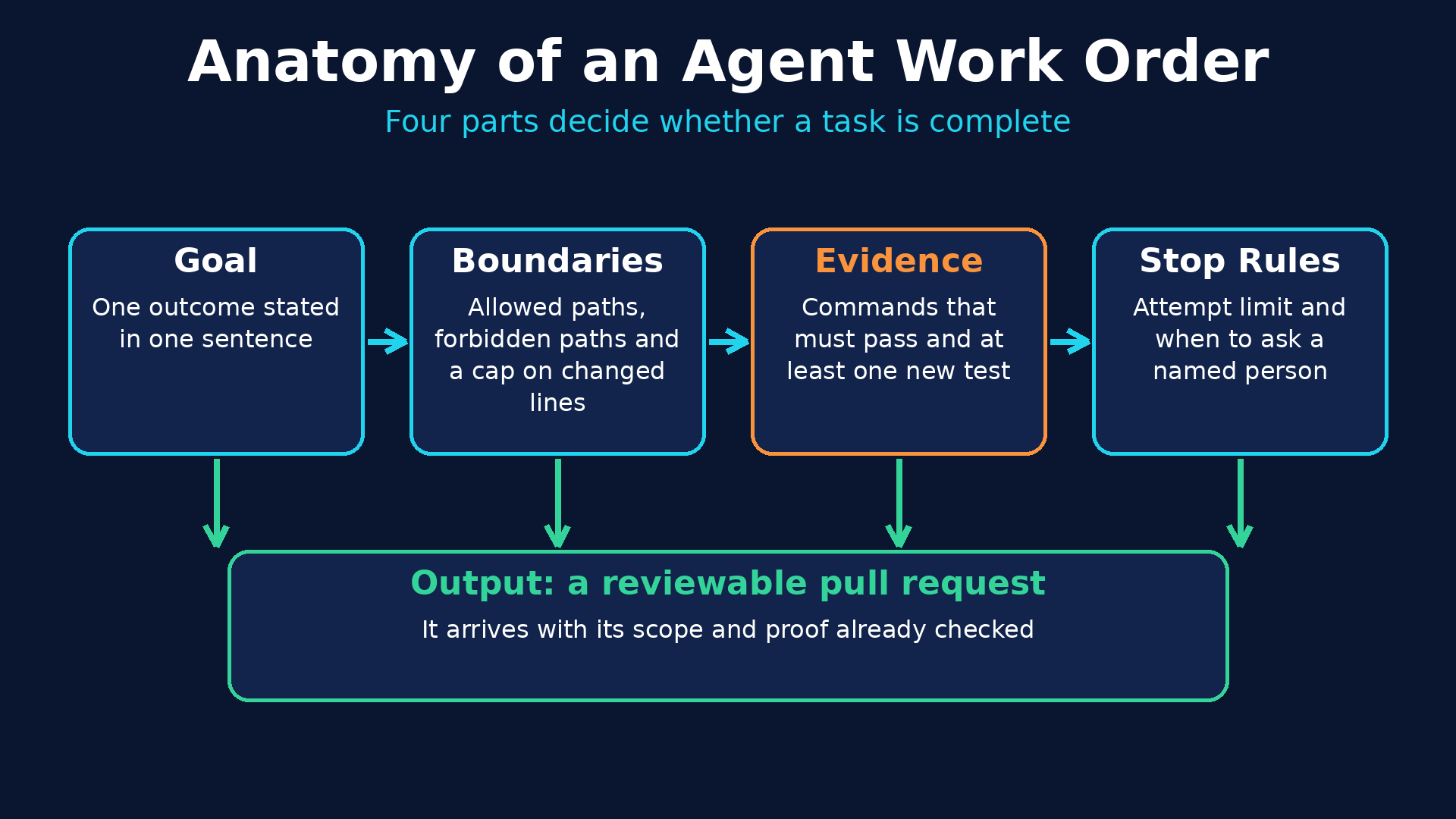
An agent task specification works when it answers four questions. What is the goal? What may the agent touch? What proves it worked? When must it stop and ask a person?
This guide calls the answer a work order: a short file next to the code with four parts, Goal, Boundaries, Evidence and Stop Rules. It is spec-driven development at the size of one ticket, and the practical core of what is agentic development.
Standing rules belong elsewhere. AGENTS.md is an open format for guiding coding agents, and its project site reports use by over 60,000 open-source projects. Agents read the nearest file, so keep repository-wide habits there and task detail in the work order.
A Work Order File You Can Copy
The file below describes a rounding bug in cart totals. Save it as orders/WO-1042.yaml, committed by a person before the agent starts.
id: WO-1042
goal: >
  Fix the rounding error in cart totals when a discount and tax
  apply to the same line item.
boundaries:
  allowed_paths:
    - "src/cart/*"
    - "tests/cart/*"
  forbidden_paths:
    - "src/payments/*"
    - ".github/*"
  max_changed_lines: 120
evidence:
  commands:
    - "pytest tests/cart -q"
    - "ruff check src/cart"
  required_new_tests: 1
stop_rules:
  max_attempts: 3
  escalate_to: "cart-team-lead"
  stop_if:
    - "the fix needs a change outside allowed_paths"
    - "an existing test must be deleted or weakened"
The goal states one outcome, because two outcomes produce two half-finished attempts. Boundaries cap the diff, so each review stays small. Evidence names the commands that must pass and demands a new test. Stop rules turn "I am stuck" into a defined event: the agent hands the task to a named person. The agent runner enforces max_attempts and escalate_to. The CI script below enforces the rest.
Quick question: what do you need to start with agentic development? You need a repository with working tests and one small task with a written goal. A named person must own the result.
How Do You Gate Agent Pull Requests With CI Quality Gates?
A work order only helps if something checks it. CI quality gates do that without trusting the agent's own summary.
The script below compares the diff with the allowed paths and size cap, counts added and removed tests, and runs every evidence command.
Any failure prints a reason and exits non-zero, so the pull request cannot merge.
order sits on the base branch. Since orders/ is not an allowed path, an agent that edits its own order fails the scope check.
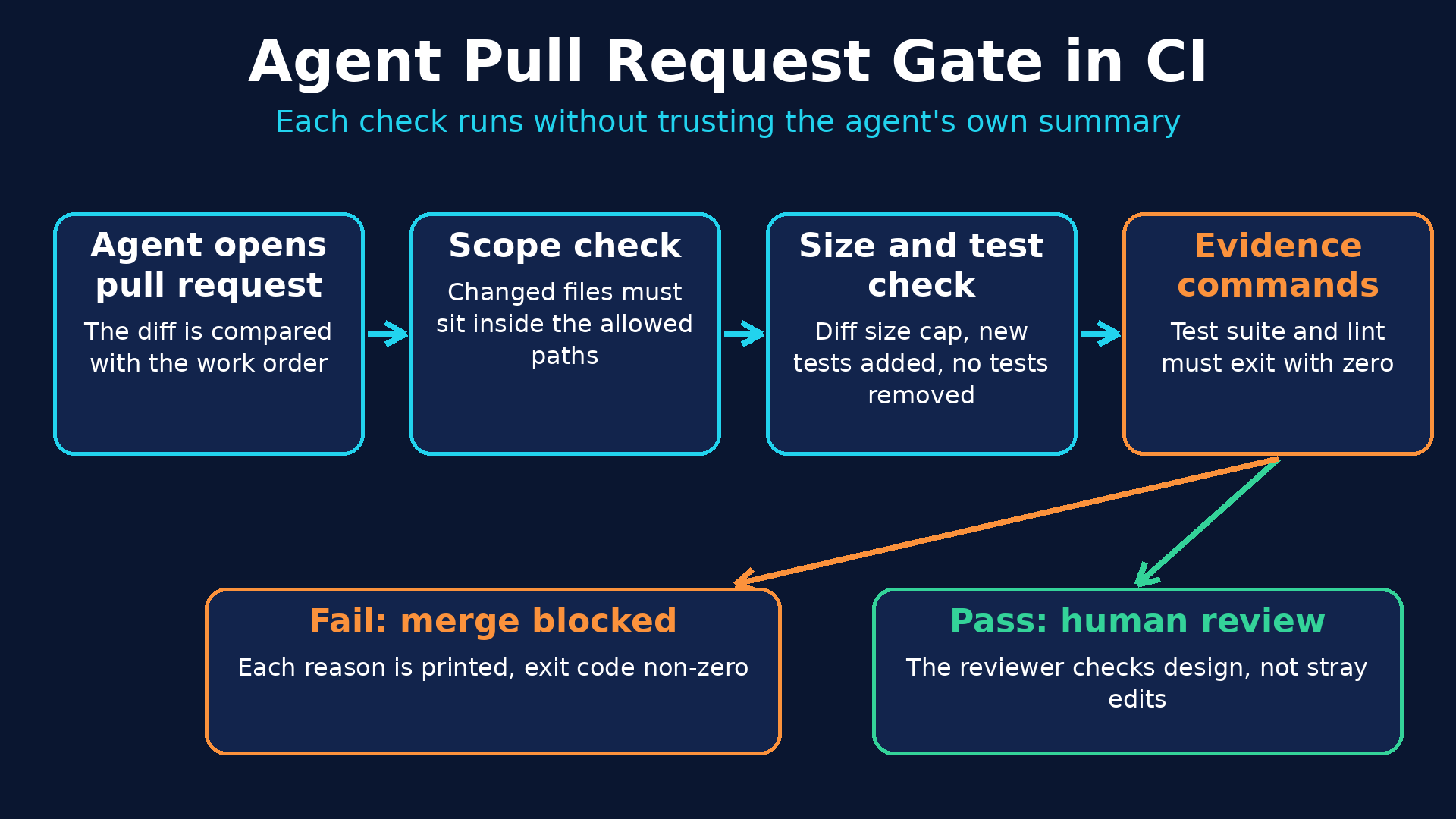
Save this as scripts/check_work_order.py:
import subprocess
import sys
from fnmatch import fnmatch

import yaml


def run(cmd):
    return subprocess.run(cmd, shell=True, capture_output=True, text=True)


def main(order_path, base):
    with open(order_path) as handle:
        order = yaml.safe_load(handle)
    bounds = order["boundaries"]
    fails = []

    for name in run(f"git diff --name-only {base}...HEAD").stdout.split():
        ok = any(fnmatch(name, p) for p in bounds["allowed_paths"])
        banned = any(fnmatch(name, p) for p in bounds.get("forbidden_paths", []))
        if banned or not ok:
            fails.append(f"out of scope: {name}")

    changed = 0
    for row in run(f"git diff --numstat {base}...HEAD").stdout.splitlines():
        added, deleted, _ = row.split("\t", 2)
        if added.isdigit() and deleted.isdigit():
            changed += int(added) + int(deleted)
    if changed > bounds["max_changed_lines"]:
        fails.append(f"diff too large: {changed} lines")

    diff = run(f"git diff -U0 {base}...HEAD -- tests").stdout.splitlines()
    new = sum(1 for line in diff if line.startswith("+def test_"))
    gone = sum(1 for line in diff if line.startswith("-def test_"))
    if new < order["evidence"]["required_new_tests"]:
        fails.append(f"expected new tests, found {new}")
    if gone:
        fails.append(f"{gone} test(s) removed or renamed")

    for command in order["evidence"]["commands"]:
        if run(command).returncode != 0:
            fails.append(f"evidence failed: {command}")

    for fail in fails:
        print(f"FAIL {fail}")
    if not fails:
        print("PASS work order satisfied")
    sys.exit(1 if fails else 0)


if __name__ == "__main__":
    main(sys.argv[1], sys.argv[2])
Then save the workflow below as .github/workflows/work-order-gate.yml. The full-history checkout supports the three-dot diff.
name: work-order-gate
on:
  pull_request:
    branches: [main]
jobs:
  gate:
    runs-on: ubuntu-latest
    steps:
      - uses: actions/checkout@v4
        with:
          fetch-depth: 0
      - uses: actions/setup-python@v5
        with:
          python-version: "3.12"
      - run: pip install pyyaml pytest ruff
      - run: python scripts/check_work_order.py orders/WO-1042.yaml origin/main
This is agent guardrails at the level of one task. Human-in-the-loop code review still happens. The reviewer simply opens a pull request that has already passed its gate.
Agents bring benefits and risks. The benefit is throughput: they take on dependency bumps and test backfill while engineers focus on design. The risk is quality.
Agents bring benefits and risks.
The benefit is throughput: they take on dependency bumps and test backfill while engineers focus on design.
The risk is stability. Google's 2025 DORA report surveyed nearly 5,000 technology professionals. It found that AI adoption now improves software delivery throughput but still increases delivery instability.
Teams are moving faster, yet their systems have not evolved to manage that speed safely. That gap is the review half of what is agentic development: the agent executes, and the gate verifies.
Quick question: why check scope in CI and not in the prompt? A prompt is a request. A CI check is a rule the agent cannot talk its way past.
Which Tasks Should Teams Hand to Agents First?
Start where proof already exists. This ranking orders task types by spec clarity and automatic verification, which is what teams asking what is agentic development usually want.
| Task type | Spec clarity | Proof available before work starts | Hand to an agent? |
|---|---|---|---|
| Dependency bump | High | Existing test suite | Yes, start here |
| Test backfill | High | Coverage report | Yes, start here |
| Bug fix with a repro | High | A failing test that must pass | Yes |
| Feature from a written spec | Medium | Acceptance tests written first | Yes, after the three above |
| Schema migration | Medium | Staging data and a rollback plan | Agent drafts, a person runs |
| Architecture change | Low | No command can judge a design | No, keep human-led |
Agents get harder work as the team's tests get stronger. A team with thin coverage should make test backfill its first order.
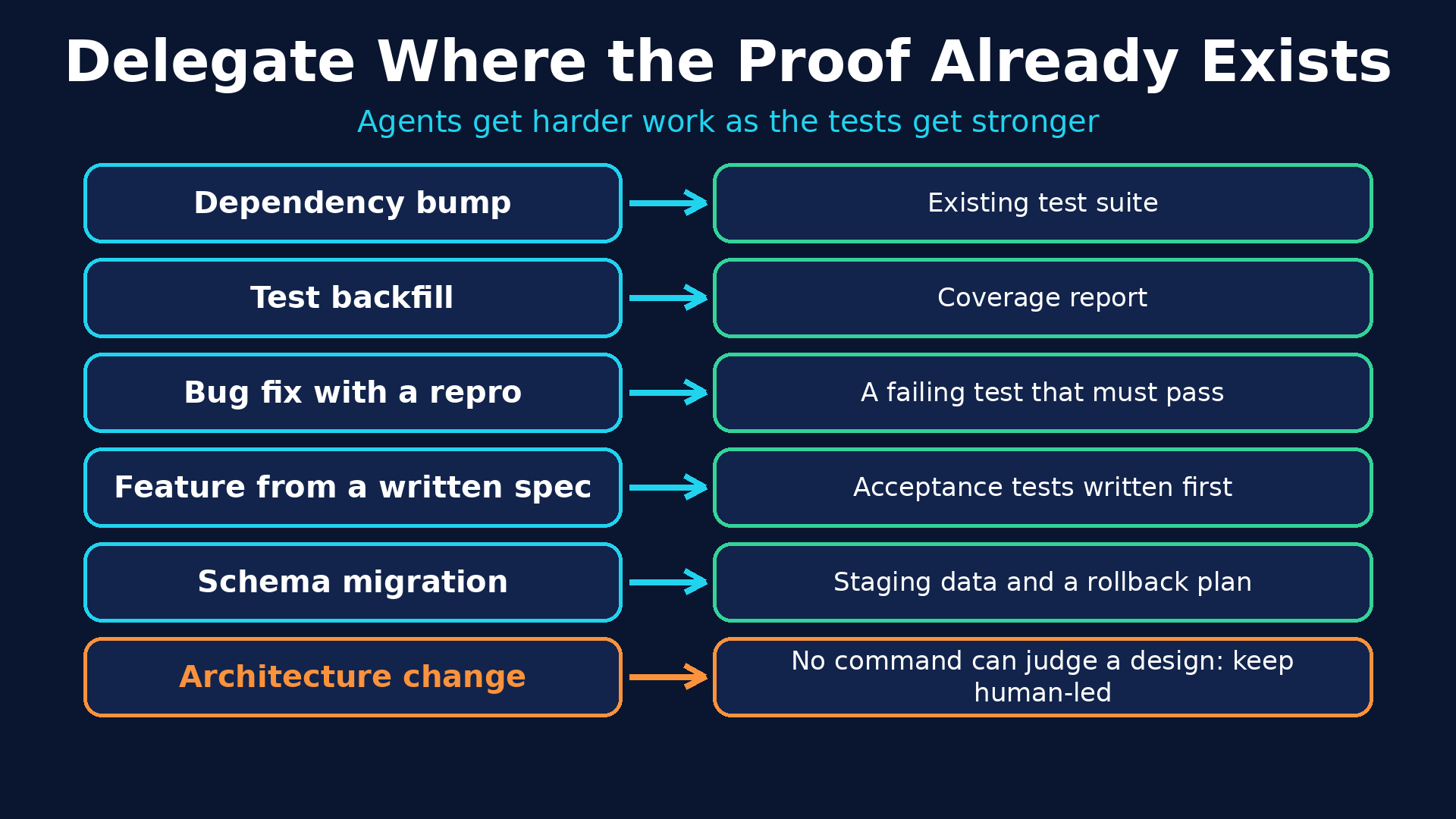
Quick question: how much autonomy should an AI agent get? Only as much as its proof allows. Widen the boundaries one table row at a time, after the gate passes several orders cleanly.
When Does Agentic AI Software Development Need a Platform?
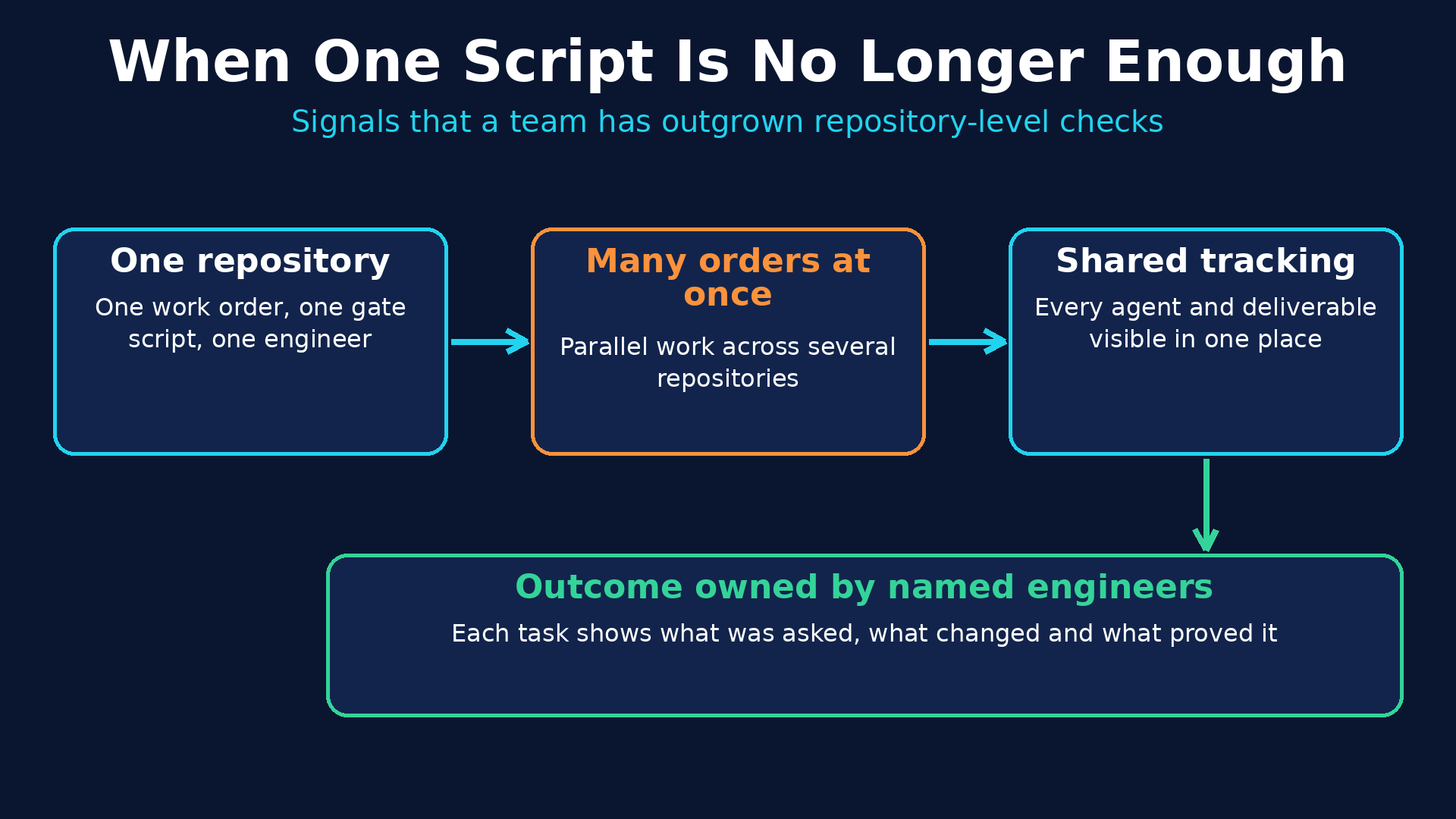
Most answers to what is agentic development stop at the definition. The harder part starts when many work orders run across several repositories. Reviewers then lose track of which is open, which stopped and who owns it.
Three signals suggest looking beyond scripts. Parallel orders outnumber reviewers. The work spans design through deployment. A legacy backlog keeps stalling new work.
At that point, agentic AI software development becomes a delivery model, not a repository habit. Engineers own the outcome, specialized agents work in parallel, and every deliverable is tracked in one place. Judge any such setup by your script's test: can it show what was asked, what changed and what proved it?
What Should Your First Five Work Orders Teach You?
Treat your first five work orders as an experiment, not a rollout. Keep one log row per order: which gate check failed, whether a stop rule fired, where a person had to step in, and how many review and rework hours the merged pull request took.
Each pattern points to a fix. Repeated scope failures mean the allowed paths are too wide or too vague. A stop rule that fires every time means the goal bundles two outcomes.
Frequent human edits mean a missing line in the order or in AGENTS.md. When rework hours fall, move one row down the task table. When the log shows that coordination, not quality, is the bottleneck, a delivery platform starts to pay off.
Orders wait on reviewers, and nobody is sure which one is open. That is the stage platform-led software delivery from Xccelera addresses, pairing engineers with specialized AI agents so parallel work stays tracked.
Until then, the answer to what is agentic development is a habit. Every task is complete before it starts, checked when it ends and owned by a named person.
The practical answer to what is agentic development is a habit, not a tool. Every task is complete before it starts, checked when it ends and owned by a named person.
Quick question: will agentic development replace software engineers? Not on current evidence. Agents execute well-specified tasks, while engineers write the specs and judge designs.
About the author
- Xccelera AI is an enterprise agentic AI platform for building, orchestrating, integrating and scaling AI agents, from AI transformation strategy to production software engineering. Our platform and packaged agents (voice, ERP, ITSM, clinical assist, negotiation) come with human approval checkpoints, isolated execution and an audit-ready evidence trail for every run. Here we share engineering deep-dives on agent design, orchestration and observability. xccelera.ai
Comments
Join the discussionNo comments yet. Be the first to comment.