
AI Agent Builders With Governance and Guardrails
A guardrail you cannot diff cannot be reviewed. Here is how to enforce limits with a manifest, a schema and a CI gate.
A guardrail you cannot diff is a guardrail you cannot review. That single test separates serious AI agent builders with guardrails from builders that merely display them.
Many platforms offer toggles, filters and a policy page. Few let an engineer open one file, read every limit an agent runs under, and watch a failed check block the release.
This guide covers what governed agent building must enforce, why interface settings fall short, and how to define guardrails as code. It closes with the checks that should stop a release and the questions to ask any vendor.
What Should AI Agent Builders With Guardrails Actually Enforce?
Effective AI agent builders with guardrails enforce limits at two separate moments. At build time, they decide what an agent is allowed to be. At run time, they decide what it may do next. Most platforms cover the second moment and ignore the first. As a result, the release itself stays ungoverned.
Build-Time Guardrails Decide What an Agent Can Become
Build-time guardrails describe the agent before it executes anything. They fix its purpose, its owner, the tools it may call, the data it may read and the budget it may spend. Because these rules are static, a reviewer can read them like any other configuration.
Rejecting a bad agent at this stage costs one comment on a pull request. Catching the same problem after launch costs an incident, a rollback and an uncomfortable meeting.
Therefore, push every rule that can be decided in advance into the build step, and reserve run time for decisions that depend on live context.
Run-Time Guardrails Decide What an Agent May Do Next
Run-time guardrails act on live behavior. Each tool call gets checked against the manifest before it executes, and anything outside the declared scope fails closed.
Step counters stop loops, spend meters stop cost spikes, and approval gates pause risky writes until a named person answers. A kill switch ends the run when everything else misses.
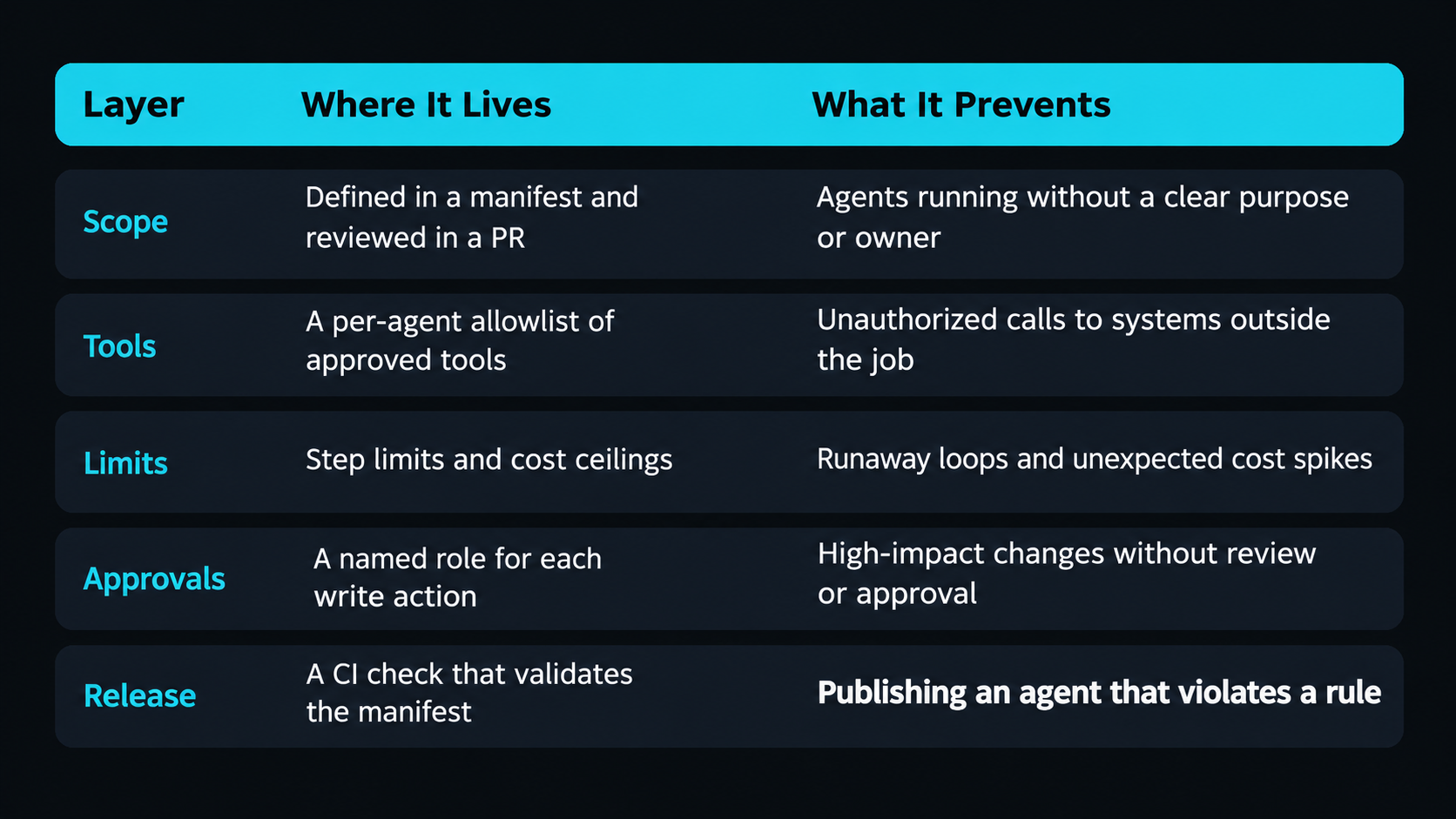
The table below maps five layers to the place each one lives and the failure it blocks. Notice that the last two layers connect build time to run time, which is exactly where most builders leave a gap.
Why Can't UI Toggles Count as Guardrails in an AI Agent Builder?
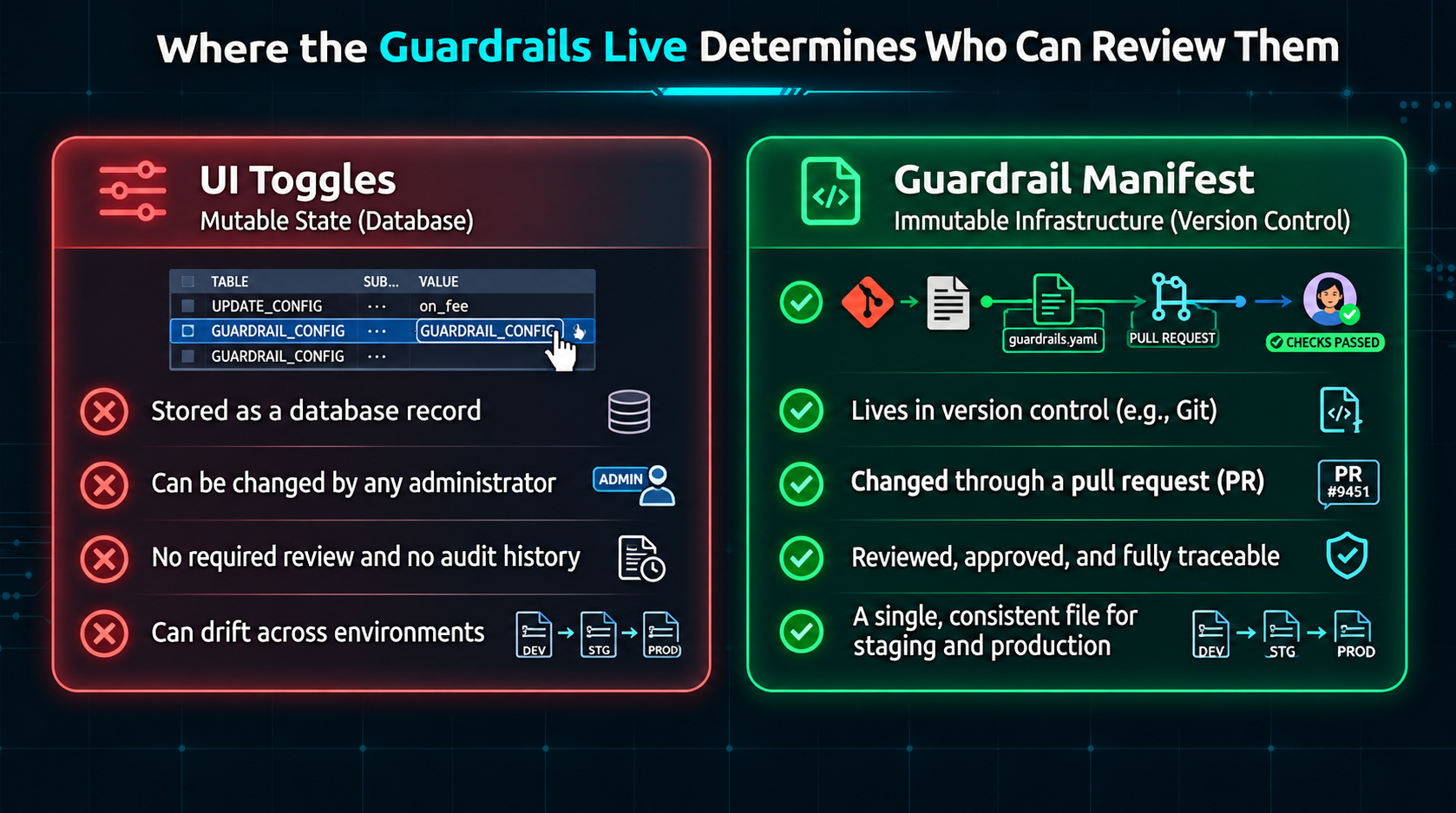
A toggle shows the current state of a setting. It does not show who changed it, why, or what it replaced. Reviewers cannot approve a state they cannot see, and auditors cannot trace a change nobody recorded.
A Toggle Leaves No Diff to Review
Interface settings usually live in a database row that any administrator can edit. No pull request exists, so no reviewer sees the change. A limit that quietly rose from ten steps to fifty leaves no trace beyond a timestamp, if that.
Files behave differently. A file in version control carries an author, a message, a reviewer and a history. Anyone can run git blame on a spend ceiling and learn who raised it and under which ticket. That accountability is the whole point of treating guardrails as code.
Settings Drift Between Staging and Production
Toggles also drift. A team tightens limits in staging, then forgets to mirror them in production, or loosens one temporarily and never restores it. Nothing flags the gap because no single artifact describes both environments. A manifest solves this by travelling with the agent version.
The same file that passed review in staging gets promoted to production unchanged, so the guardrails a reviewer approved are the guardrails that run. Environment differences, such as a lower spend cap in staging, become explicit overrides instead of silent divergence.
How Do You Define Guardrails as Code for an AI Agent?
The pattern has three parts: a manifest, a schema and a gate. The manifest declares limits. The schema defines what a valid manifest looks like. The gate runs both on every pull request. This works with any builder that exports its agent configuration, and it scales when AI agent orchestration coordinates several agents through one release pipeline.
A Manifest With Tool Allow list, Limits and Approvers
Start with a short file that names the agent, its owner, its tools, its ceilings and its approvers. Mark each tool as read or write, because write access is where approvals matter.
Keep tool names aligned with the AI agent connectors your integration layer exposes, so an allow list entry maps to exactly one governed route into a system.
Save the file as agent.guardrails.yaml next to the agent code. Keep it small enough to read in one sitting. Reviewers then see the whole risk profile in about fifteen lines.
agent: renewal-reminder
owner: revenue-ops@example.com
tools:
  - name: crm.accounts
    access: read
  - name: email.send
    access: write
limits:
  max_steps: 12
  max_spend_usd: 5
approvals:
  - action: email.send
    approver: revenue-ops-lead
kill_switch: true
A CI Gate That Refuses to Publish a Failing Agent
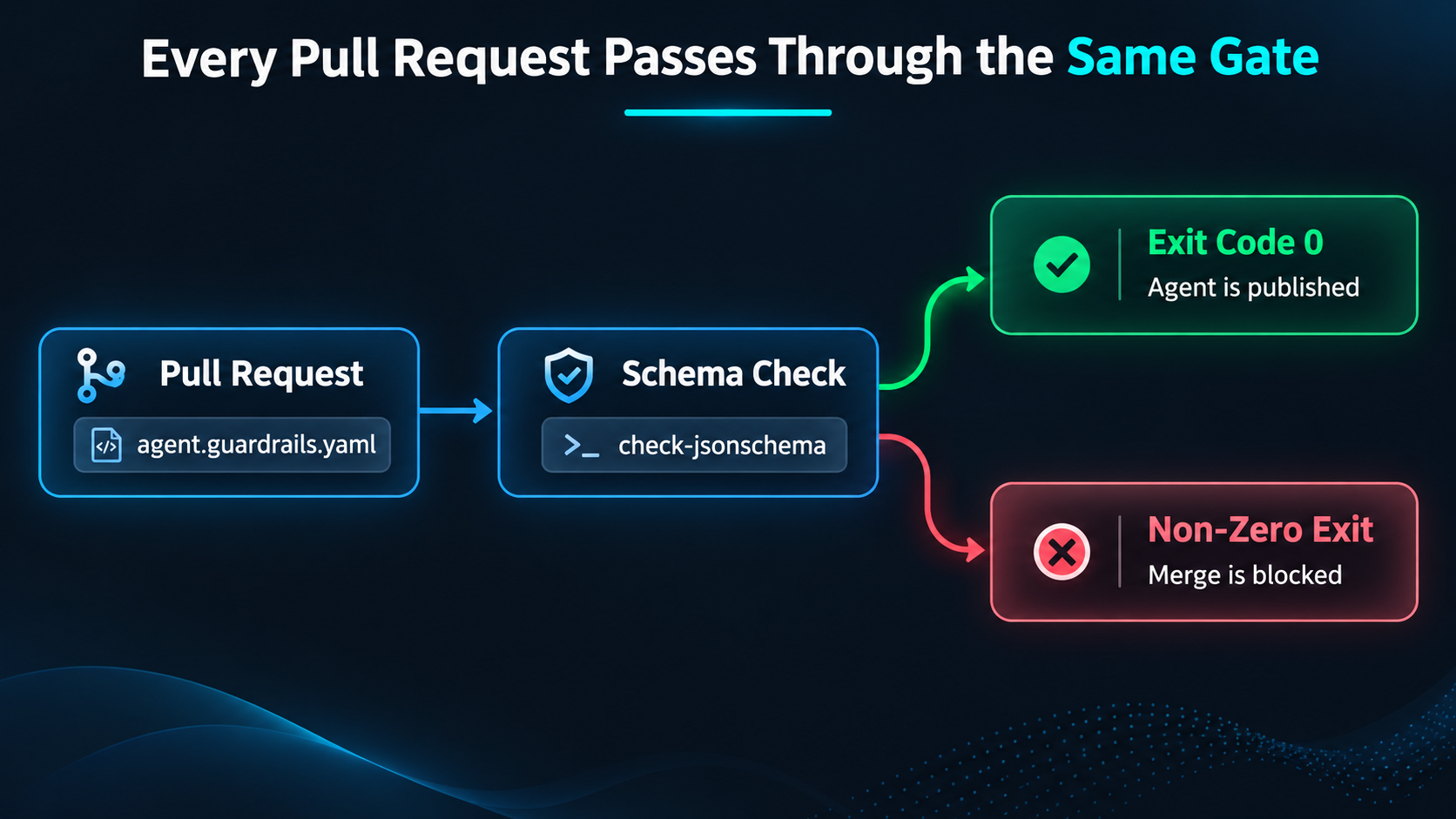
A manifest only matters if something enforces it. Add a JSON Schema that rejects missing owners, unbounded spend and write tools without an approver.
Then run the schema in CI with check-jsonschema, which reads YAML directly. The job fails the pull request when any rule breaks, so a non-compliant agent never reaches the publish step.
the check returns a non-zero exit code, the same command also works locally before you push.
Save the schema as guardrails.schema.json and the workflow as .github/workflows/agent-gate.yml.
{
  "$schema": "https://json-schema.org/draft/2020-12/schema",
  "type": "object",
  "required": ["agent", "owner", "tools", "limits", "approvals", "kill_switch"],
  "additionalProperties": false,
  "properties": {
    "agent": { "type": "string", "minLength": 3 },
    "owner": { "type": "string", "pattern": "^[^@\\s]+@[^@\\s]+\\.[^@\\s]+$" },
    "tools": {
      "type": "array",
      "minItems": 1,
      "items": {
        "type": "object",
        "required": ["name", "access"],
        "additionalProperties": false,
        "properties": {
          "name": { "type": "string" },
          "access": { "enum": ["read", "write"] }
        }
      }
    },
    "limits": {
      "type": "object",
      "required": ["max_steps", "max_spend_usd"],
      "additionalProperties": false,
      "properties": {
        "max_steps": { "type": "integer", "minimum": 1, "maximum": 50 },
        "max_spend_usd": { "type": "number", "exclusiveMinimum": 0, "maximum": 100 }
      }
    },
    "approvals": {
      "type": "array",
      "items": {
        "type": "object",
        "required": ["action", "approver"],
        "additionalProperties": false,
        "properties": {
          "action": { "type": "string" },
          "approver": { "type": "string" }
        }
      }
    },
    "kill_switch": { "const": true }
  },
  "if": {
    "properties": {
      "tools": {
        "contains": {
          "required": ["access"],
          "properties": { "access": { "const": "write" } }
        }
      }
    }
  },
  "then": {
    "properties": { "approvals": { "minItems": 1 } }
  }
}
name: agent-guardrail-gate
on:
  pull_request:
    paths:
      - "agent.guardrails.yaml"
      - "guardrails.schema.json"
jobs:
  gate:
    runs-on: ubuntu-latest
    steps:
      - uses: actions/checkout@v4
      - uses: actions/setup-python@v5
        with:
          python-version: "3.12"
      - run: pip install check-jsonschema
      - run: check-jsonschema --schemafile guardrails.schema.json agent.guardrails.yaml
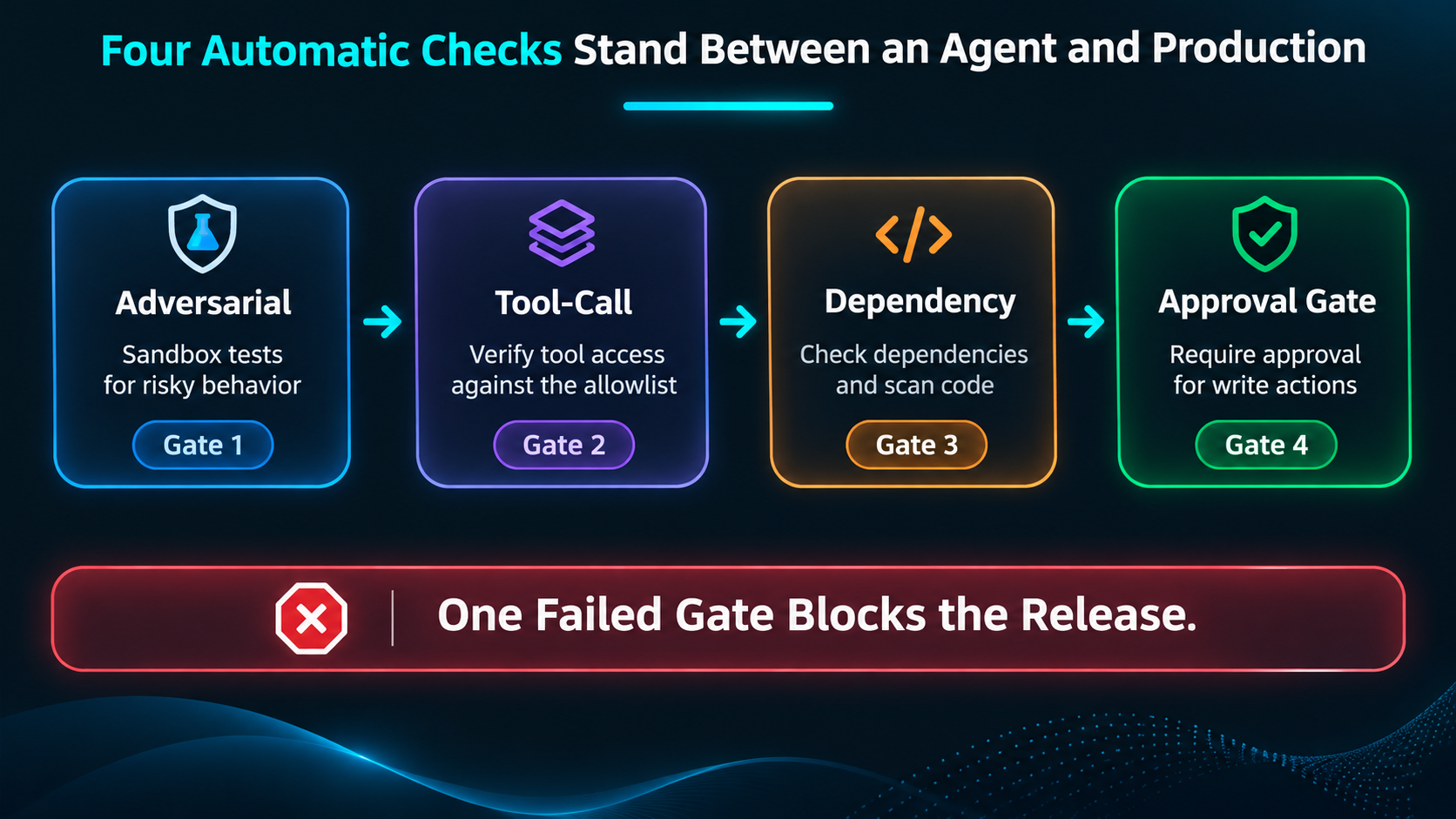
Which Checks Should Block an AI Agent From Reaching Production?
Release blockers should be few, automatic and impossible to skip. Each one needs a clear pass or fail result, because a warning that nobody must answer is only a suggestion.
Sandbox Tests and Dependency Checks
Run the agent against adversarial inputs in a sandbox, and assert on tool calls rather than replies. A polite answer can hide a forbidden call, so fail the build when any call falls outside the allowlist.
Next, scan the code and dependency tree. Agents ship with packages, and an outdated library opens the same door as a clever prompt.
Make dependency scanning a hard blocker in any 10-step walkthrough from idea to deployed agent, with fixes verified by regression tests before release. Record each result with the manifest version so evidence stays attached to the release.
Human Approval for High-Impact Actions
Approvals belong to actions, not to agents. Declare each write action that needs a human, name the approving role, and set a timeout. If nobody answers in time, the action should fail closed instead of proceeding.
Prefer a role over an individual, so a holiday does not stall the queue or tempt anyone into a shared login.
Record the approver and the decision against the manifest version that was running. That record lets a reviewer later confirm the rule existed before the action happened.
How Do You Judge Governance in an AI Agent Builder Before Adopting It?
Run any shortlisted builder through six questions. A vendor that answers yes to all of them lets you verify guardrails yourself instead of trusting a slide.
- Can you export every guardrail as a file that lives in version control?
- Does the same file apply unchanged in staging and production?
- Does a failed check block publishing, or does it only warn?
- Does each agent run under its own identity with a named owner?
- Can you see who changed a limit, and when?
- Does a kill switch exist, and has anyone tested it?
Score each answer as yes, partial or no, and weigh the first three most heavily. Exportable, promotable and blocking guardrails give you evidence you can inspect. The remaining three describe operations that matter after launch. A builder that fails the first three is asking for trust where you need proof.
How Does Xccelera Approach Governed Agent Building?
Xccelera treats governance as part of how an agent gets built, not a layer added afterward. Its AI agent creation and orchestration platform generates production-quality agent code with role-based access control, human approval gates, six layers of built-in guardrails and full audit trails from the first commit.
It works across major LLM providers with no vendor lock-in, so the same controls follow an agent wherever the model runs.
Teams that once spent months assembling infrastructure move from blueprint to deployed agent in hours, and every release carries evidence of what was approved and why.
For engineering leaders, that turns governance from a review bottleneck into a default property of every agent the team ships.
About the author
- Xccelera is an AI-first transformation company delivering advanced Agentic AI Services and scalable AI Solutions designed to help enterprises & SMBs to automate work, accelerate decision-making, and modernize operations with autonomous intelligence. We build, deploy and maintain production-ready AI Agents that function as digital workers capable of executing tasks, collaborating across systems, and adapting to real-world conditions. Businesses can integrate our agents into existing workflows or adopt them directly for immediate impact. Each agent is engineered for accuracy, speed, and enterprise reliability, empowering organizations to reduce operational effort, increase productivity, and scale intelligently in a fast-changing digital environment.
Comments
Join the discussionNo comments yet. Be the first to comment.