Engineering Notes: Passing an ISO 42001 Readiness Assessment
Engineering teams rarely fail ISO 42001 because their models are unsafe. They fail because nobody can produce the paperwork proving the models are being watched.
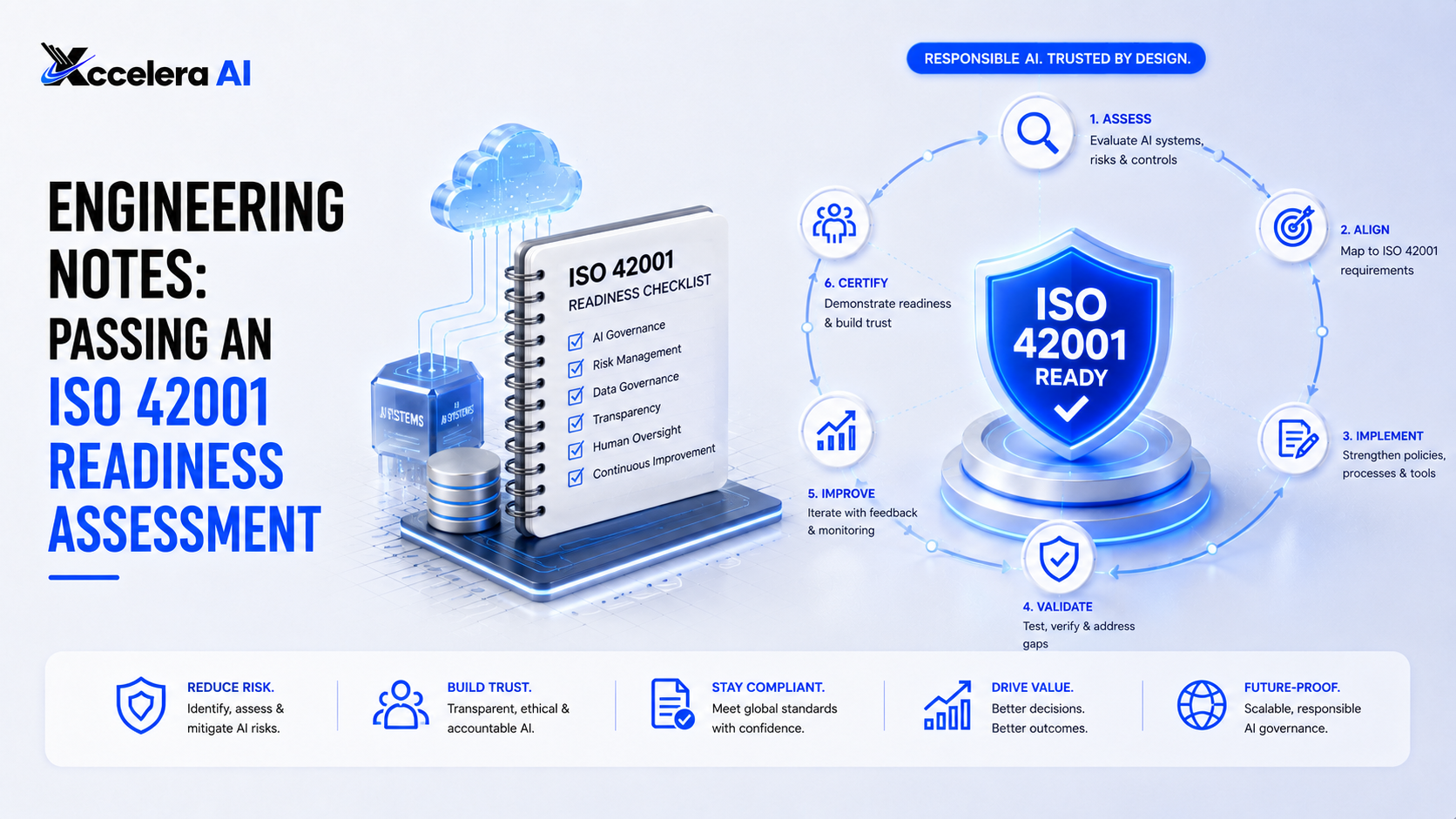
An ISO 42001 readiness assessment exists precisely to catch that gap before an external auditor does, and for engineering leaders it functions less like a compliance checkbox and more like a systems audit of how agentic workflows actually run in production.
The standard does not ask whether an organization builds responsible AI in theory. It asks for evidence: risk registers, impact assessments, model lifecycle records, and a working feedback loop between the people running the system and the people governing it.
A structured ISO 42001 readiness assessment ensures these governance artifacts already exist before formal review, making the overall ISO 42001 certification process significantly smoother while strengthening AI governance controls across engineering operations.
Where Auditors Actually Focus During Stage 1
Certification bodies spend the first audit stage reading documentation, not testing systems, and that distinction changes what engineering teams should prepare first. Strong Stage 1 audit documentation is therefore the foundation of every successful ISO 42001 readiness assessment and AI management system audit.
Policy documents without operational artifacts
A single AI policy page rarely survives scrutiny. Auditors expect that policy to trace directly into a live risk register, named control owners, and dated evidence that each control has actually executed at least once.
Teams that treat the policy as the deliverable, rather than the entry point into daily engineering practice, tend to walk into Stage 1 with nothing an auditor can sample.
A policy that references controls no engineer has ever operated reads as intent rather than implementation, and reviewers are trained to spot that gap within the first hour of document review.
Comprehensive Stage 1 audit documentation should clearly connect every policy to an active risk register and impact assessment, demonstrating that AI governance controls operate in production rather than existing only on paper. This is the same gap between a written policy and an operating control that shows up in a practical checklist for AI agent identity, access control, and monitoring, which treats access and monitoring as controls that must actually run, not just be documented.
Mapping controls to existing security work
Organizations already certified against adjacent frameworks inherit a meaningful head start, since risk methodology, incident response, and access management transfer directly into an AI management system.
The remaining effort concentrates on AI specific controls such as bias testing, training data lineage, and drift monitoring, which rarely exist anywhere in a standard security stack until someone builds them on purpose.
During an AI management system audit, these AI governance controls become central evidence supporting the ISO 42001 certification process while strengthening AI agent compliance across production environments.
Why Engineering Teams Underestimate the Preparation Timeline
Most delays in an ISO 42001 readiness assessment program trace back to one miscalculation: treating governance as a documentation sprint instead of an operational build.
Evidence has to be produced, not written
A management review or internal audit cannot be backfilled convincingly. Auditors sample records across a period of active operation, so an AI management system needs weeks of real execution behind it, including completed impact assessments and logged risk treatments, before Stage 1 ever begins.
Engineering calendars that budget two weeks for governance typically discover the real number closer to a full quarter.
Consistent Stage 1 audit documentation supported by a complete risk register and impact assessment demonstrates that the AI management system has been operating continuously rather than assembled immediately before the audit. This same underestimation shows up in why 80% of enterprise AI agent pilots never reach production, where teams that treat governance as a late-stage retrofit consistently run out of runway before a formal review.
Ownership gaps inside agent pipelines
Multi agent systems complicate accountability because a single workflow may touch several models, vendors, and decision points before producing an output.
Each of those handoffs needs a named owner and a monitoring signal, or the audit trail breaks exactly where a regulator would look first.
Engineering teams that map ownership only at the project level, rather than at each handoff inside the pipeline, discover during Stage 2 that nobody can explain why a specific decision was routed to a specific agent on a specific date. This exact handoff-level accountability problem is why multi-agent orchestration as the enterprise control plane centralizes ownership and policy across every agent instead of leaving it scattered per project.
This level of traceability is increasingly expected during an AI management system audit and is essential for demonstrating AI agent compliance throughout the ISO 42001 certification process.
Turning Governance Into an Engineering Discipline
Passing an ISO 42001 readiness assessment ultimately depends on whether governance artifacts are generated automatically by the systems doing the work, rather than assembled after the fact by a compliance team scrambling for evidence.
Instrumenting agents for continuous evidence
Production agent fleets that log model versions, decision rationale, and human override events create audit evidence as a byproduct of normal operation.
That shifts governance from a quarterly fire drill into a standing property of the architecture, which is the posture every accredited auditor is actually trained to look for.
It also removes the scramble that typically precedes an external visit, since the evidence already exists inside the system instead of living in a spreadsheet someone updates the week before Stage 1.
Automated evidence collection also strengthens AI governance controls while improving AI agent compliance and maintaining complete Stage 1 audit documentation over time. This same shift, from a periodically-updated log to continuous, self-generating evidence, is the operating model behind why customer support triage needs an agent lifecycle strategy, not just chatbots, where decision logging and version control run continuously rather than as a one-time setup step.
Closing the loop between risk and deployment
A risk register that never touches deployment decisions is decoration. Effective teams route new AI use cases through the same register before shipping, so the documentation an auditor eventually reviews reflects decisions that were made, not decisions that were reconstructed for the visit.
That single habit, checking the risk register and impact assessment before a launch rather than after an incident, is the difference reviewers cite most often between organizations that pass on the first attempt and those that need a second cycle.
Organizations conducting an ISO 42001 readiness assessment consistently discover that integrating AI governance controls directly into deployment decisions simplifies the ISO 42001 certification process. Testing that a deployment decision actually holds up before it reaches production is the same discipline behind agentic AI testing and quality assurance, where verification runs continuously rather than as a pre-launch checklist item.
Building the Operational Backbone for Continuous Compliance
Enterprises that treat orchestration, observability, and human in the loop review as native platform capabilities move through certification with far less friction than those retrofitting governance onto disconnected tools.
Xccelera's AI agent orchestration and engineering platform gives engineering teams a single system of record for agent behavior, decision logging, and human oversight, the same operational backbone an ISO 42001 readiness assessment expects to see functioning under real workloads. By supporting AI governance controls, AI agent compliance, continuous risk register and impact assessment workflows, and the evidence required during an AI management system audit, the platform helps organizations prepare for every stage of the ISO 42001 certification process.
Teams evaluating their governance posture can review the platform's approach to production grade agent oversight at https://xccelera.ai/.