
Engineering Guardrails for Agents That Own Production Deployments
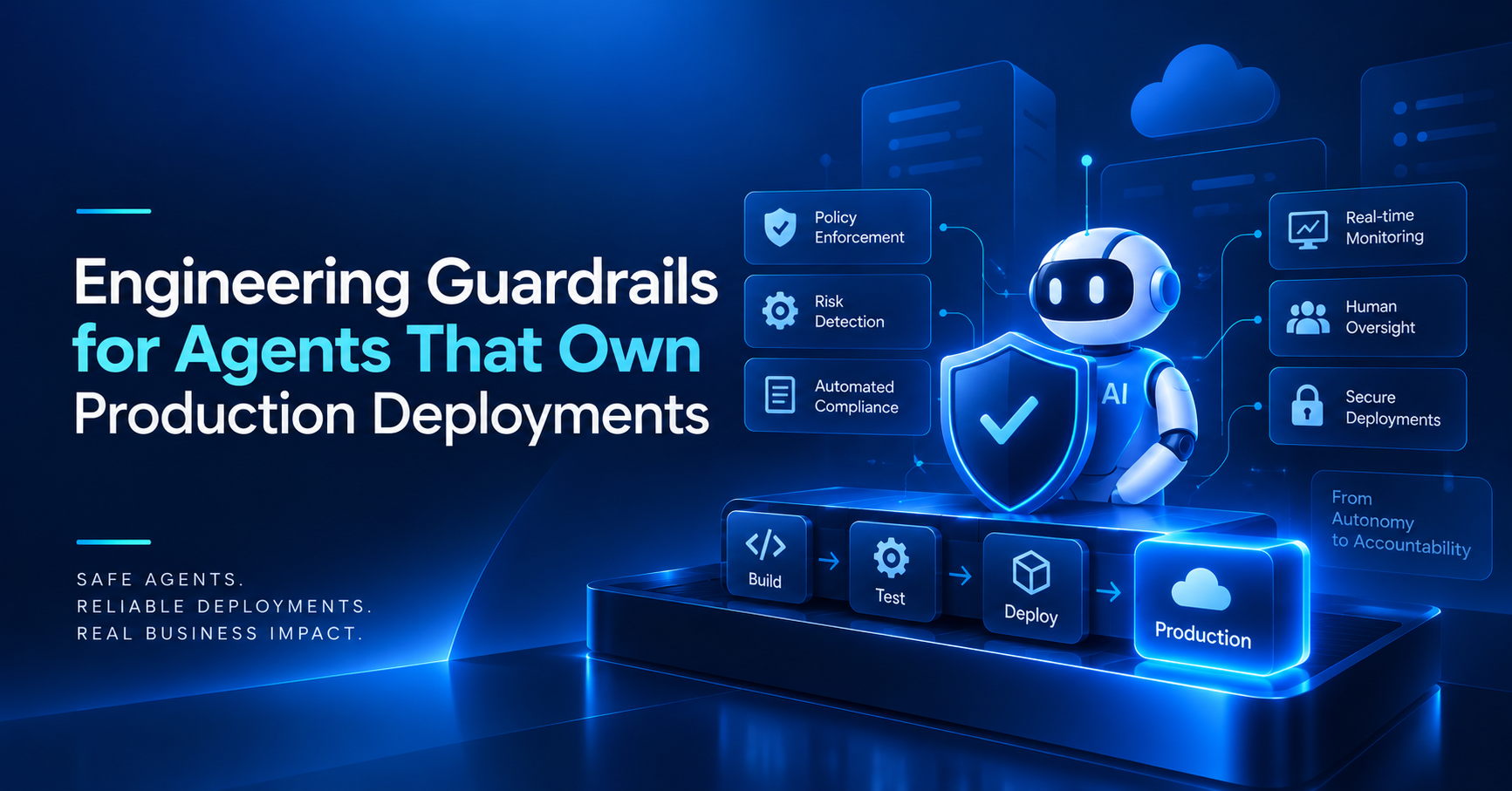
Summary: Autonomous agents now push code, touch customer data, and trigger financial transactions without a human clicking approve. That shift makes AI agent guardrails a board-level concern, not an engineering afterthought. Enterprises that skip production AI deployment risk controls face outages, compliance exposure, and runaway cloud spend.
This article breaks down what real autonomous agent governance looks like at scale, from decision boundaries to full agent lifecycle management, and shows how disciplined enterprise agentic AI controls turn agents into dependable infrastructure instead of unpredictable liabilities.
Why Autonomous Agents Running Production Systems Demand New Control Architectures
Agents no longer wait for a human to approve every action. They read tickets, write code, deploy it, and roll back when something breaks. That autonomy is exactly why AI agent guardrails matter so much right now. Traditional software controls assume a person is in the loop at each decision point. Agents remove that assumption entirely.
The Autonomy Gap Nobody Budgeted For
Most engineering teams built their release pipelines around human review gates. An agent that generates a pull request, merges it, and deploys within minutes breaks that model completely. As a result, organizations need agent decision boundaries defined before deployment, not discovered after an incident.
Gartner projects nearly 40 percent of enterprise applications will embed task-specific AI agents by the end of 2026, up sharply from under 5 percent in 2025. That pace leaves little room for retrofitting safety after the fact.
For example, an agent with standing production database credentials can delete records just as easily as it updates them. Without explicit boundaries, speed becomes the risk multiplier rather than the benefit.
The Hidden Cost of Ungoverned Agent Decision-Making at Enterprise Scale
Ungoverned agents do not fail loudly. They fail quietly, compounding small errors until the damage is expensive to unwind. Production AI deployment risk rarely shows up as a single dramatic event. It shows up as drift.
What McKinsey and Deloitte Are Actually Seeing
Despite heavy investment, most agent programs stall before they scale. McKinsey research shows well over half of organizations are actively piloting AI agents, yet fewer than a quarter have successfully scaled them into production, and that gap traces back to governance rather than technology.
In practice, the agents that do reach production often carry permissions far broader than their task requires, which turns a minor logic error into a system-wide incident. That said, cost overruns follow the same pattern. An agent with an unmetered token budget can burn through a monthly cloud allocation in a single bad loop, and nobody notices until the invoice arrives.
Governance Gap | Typical Consequence | Guardrail That Prevents It |
No agent decision boundaries | Unauthorized production actions | Scoped, task-specific permissions |
Missing cost controls | Runaway LLM spend | Per-request and per-day token budgets |
No audit trail | Unexplainable incidents | Full action-level logging |
No approval gates | Irreversible deployment errors | Human-in-the-loop checkpoints |
Building AI Agent Guardrails That Preserve Autonomy Without Sacrificing Safety
The instinct after an incident is to lock everything down. That instinct is usually wrong. Overly rigid controls push teams to route around them, recreating the shadow AI problem enterprises are already fighting. Effective autonomous agent governance is proportional, not binary.
Scoping Permissions to the Task, Not the Team
Agents should hold time-bound, narrowly scoped credentials tied to the specific job at hand rather than broad standing access.
In practice, this means an agent handling customer support triage never touches billing infrastructure, even if the same underlying platform could technically allow it. Pattern-based detection layers reinforce this at runtime.
Real-world deployments increasingly embed checks such as PII detection, prompt injection prevention, and relevance filtering directly into the agent's business logic, so unsafe requests are blocked before they execute rather than caught afterward. Rate limiting on sensitive endpoints adds a further layer of AI agent oversight against abuse or misconfiguration.
Treating Autonomous Execution Risk as a Design Input, Not an Afterthought
Teams that model autonomous execution risk before writing a single line of agent logic make fundamentally different architecture decisions than teams that bolt on controls later.
That means asking, for every capability granted to an agent, what the worst plausible outcome looks like if that capability is misused or misfires.
A cost ceiling per request, a toxicity filter that replaces flagged content rather than blocking the entire response, and an off-topic query that returns an error instead of a hallucinated answer all come from that same design discipline applied early.
Observability and Audit Trails as the Foundation of Production Trust
You cannot govern what you cannot see. AI system observability is the difference between catching a problem in minutes and discovering it in a postmortem three weeks later.
Why Tamper-Evident Logging Changes the Incident Conversation
Security researchers increasingly point to the same root causes behind agent failures. Recent analysis found that fewer than one in five organizations effectively govern AI access to core business systems, a gap that shows up first in incomplete visibility into what agents actually did.
Every agent action, from the API call it made to the data it touched, needs to be logged in a format that survives a compliance audit. Full version history matters just as much.
When an agent modifies its own generated code, the team needs to trace exactly which version ran in production and why. That traceability turns a guessing game into a five-minute lookup.
Governing the Full Agent Lifecycle from Design Through Continuous Operation
Guardrails bolted on after launch rarely hold up. Agent lifecycle management has to start at the design stage and continue through every redeployment, not just the initial rollout.
Design, Deploy, Operate, Retire
A mature lifecycle model treats each stage differently. At design time, teams define the agent's permitted actions and cost ceiling. At deployment, human approval gates review the blueprint and projected spend before anything goes live.
During operation, continuous monitoring flags anomalous behavior against the agent's defined domain. Regulatory pressure reinforces the need for this discipline. Governance frameworks now call for autonomy tiers, retirement processes, and runtime monitoring as standard practice rather than optional extras, particularly as new transparency and high-risk obligations take effect across major jurisdictions in 2026.
Retirement deserves the same rigor as launch. An agent that no longer matches its original scope, or one whose underlying model has changed behavior, should be decommissioned deliberately instead of left running on inertia.
Xccelera's Framework for Governing Agents Across Production Environments
Enterprises need a platform that treats governance as the default output, not a bolt-on. That is the gap an AI Agent Lifecycle Management Platform is built to close.
Every agent generates ships with layered safety controls woven directly into the business logic, covering PII detection, prompt injection prevention, toxicity filtering, relevance checking, cost controls, and rate limiting.
Role-based access control separates who configures agents from who approves them and who only observes, while human-in-the-loop approval gates pause deployment at critical decision points until a reviewer signs off.
Full audit trails and version history mean every production action traces back to a specific, accountable change.
Because the platform generates real source code with no proprietary runtime lock-in, engineering teams retain full ownership and can extend guardrails as their governance needs evolve.
This is the disciplined foundation Xccelera brings to enterprises building agents that are meant to run production, not just demo well. Learn more about how Xccelera approaches agentic AI governance at xccelera.ai.