
Every engineering leader knows the feeling. A scanner lights up, and suddenly dozens of vulnerable packages sit across dozens of repositories. Fixing one is routine.
The real challenge is to batch fix CVEs across repos without stalling feature delivery or breaking production. Manual patching does not scale to that volume, and most teams already know it.
Meanwhile, attackers do not wait for your next sprint. In regulated sectors, every open vulnerability also adds audit risk. AI agents now offer a practical path forward. They scan, upgrade, test, and document fixes in parallel. This article explains how that approach works and what leaders should verify first.
Why Is It So Hard to Batch Fix CVEs Across Repos?
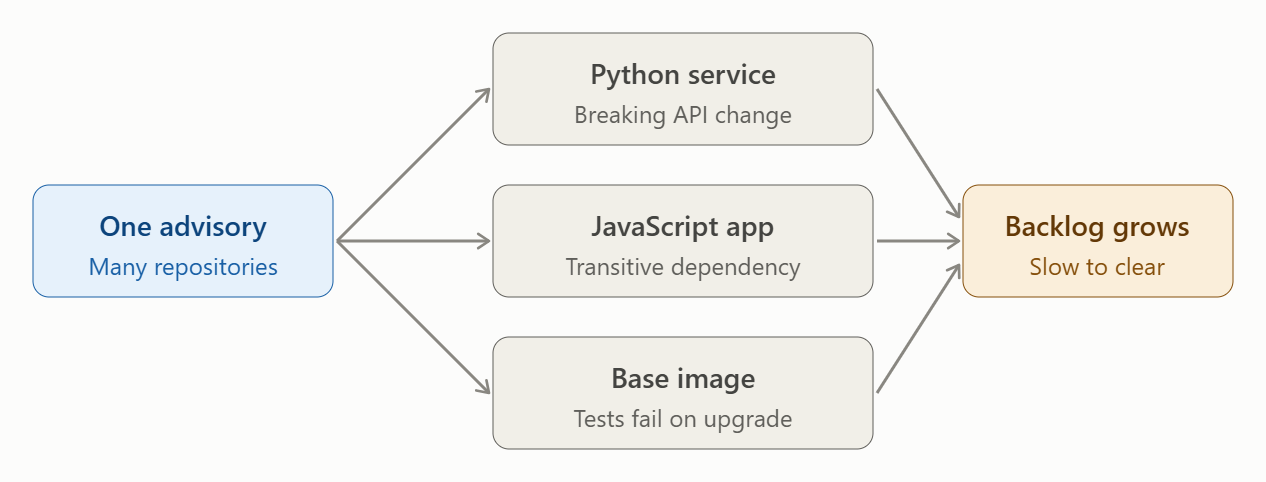
Scanners are good at finding problems. They are far weaker at resolving them. When teams try to batch fix CVEs across repos, obstacles appear almost immediately. Each repository has its own language, test suite, and owner. Consequently, one advisory can demand ten different fixes.
Transitive Dependencies and Breaking Changes
Many vulnerable packages sit three layers deep in the dependency tree. Engineers did not choose them, so upgrading them means upgrading something else first.
Moreover, major version jumps often change function signatures. A simple version bump then fails the build. Fixing the CVE now requires rewriting the calling code as well.
The Security Backlog Problem
Meanwhile, the security backlog grows faster than teams can shrink it. Each CVSS severity score demands triage, research, and review. Engineers lose days to context switching.
As a result, mean time to remediate stretches from days into weeks. That gap becomes both a security exposure and a compliance liability.
What Does an AI Agent Workflow for Multi-Repo CVE Remediation Look Like?
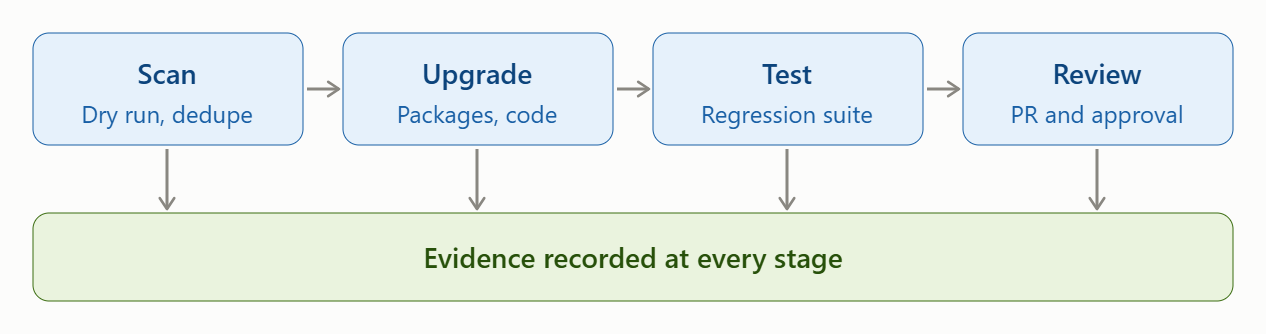
AI agents for vulnerability remediation work as a coordinated pipeline, not a single script. Each stage hands verified output to the next. Together, they turn a scattered backlog into a controlled, repeatable run.
Detect and Dedupe Across Repositories
The run begins with a dry-run scan. It maps every vulnerable package without touching production branches. Agents then cross-check multiple advisory sources, because no single feed covers every disclosure.
Finally, they group duplicate findings, so one shared library becomes one fix rather than twenty tickets. This step anchors effective multi-repo vulnerability management.
Upgrade Packages and Patch the Calling Code
Next, agents move vulnerable packages to safe versions and trace transitive dependencies. When an upgrade breaks an interface, they rewrite the affected code to match.
This is where automated vulnerability remediation differs from basic bots that only change a version number. The fix lands as a coherent change, not a half-finished one.
Test Every Fix and Open Automated Pull Requests
Afterwards, regression testing runs against each change. Failures trigger a diagnostic pass that separates upgrade-caused breaks from flaky tests. Passing fixes become automated pull requests for CVE fixes.
Each one lists the advisory, the version jump, and any code edits. Reviewers then confirm changes in minutes instead of researching from scratch.
Review and Approve With Evidence Attached
Finally, humans step in where judgment matters. Reviewers open each pull request and confirm the change in minutes instead of researching from scratch. Approval gates keep control with your team wherever policy requires it. Meanwhile, the pipeline attaches the scan, upgrade, and test results to every change. As a result, each approval leaves a traceable record.
Manual Patching vs Agent-Driven Remediation: How Do They Compare?
Leaders often ask where the real gains sit. The table below separates the two approaches across the steps that consume the most engineering time.
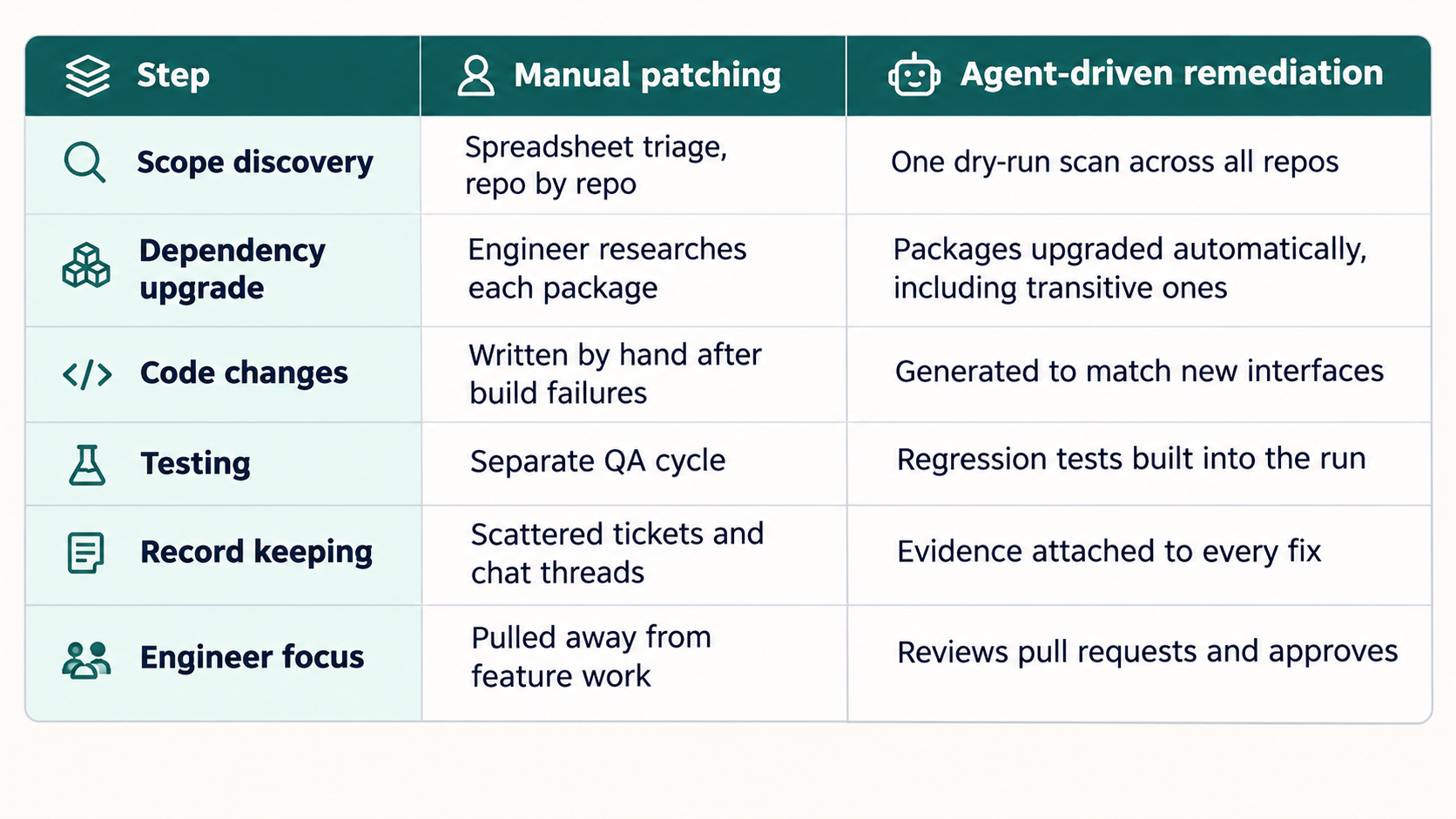
The pattern is clear. Agents remove the repetitive work, while humans keep the decisions. Therefore, teams strengthen software supply chain security without sacrificing delivery speed.
How Do You Prove a CVE Fix Actually Worked?
Fixing a vulnerability is only half the job. Auditors and boards also want proof. Teams exploring AI security and vulnerability auto-resolution can see how a fintech team cleared 22 CVEs in 45 minutes with tested, documented pull requests. That outcome depends on a pipeline that records every step as it happens.
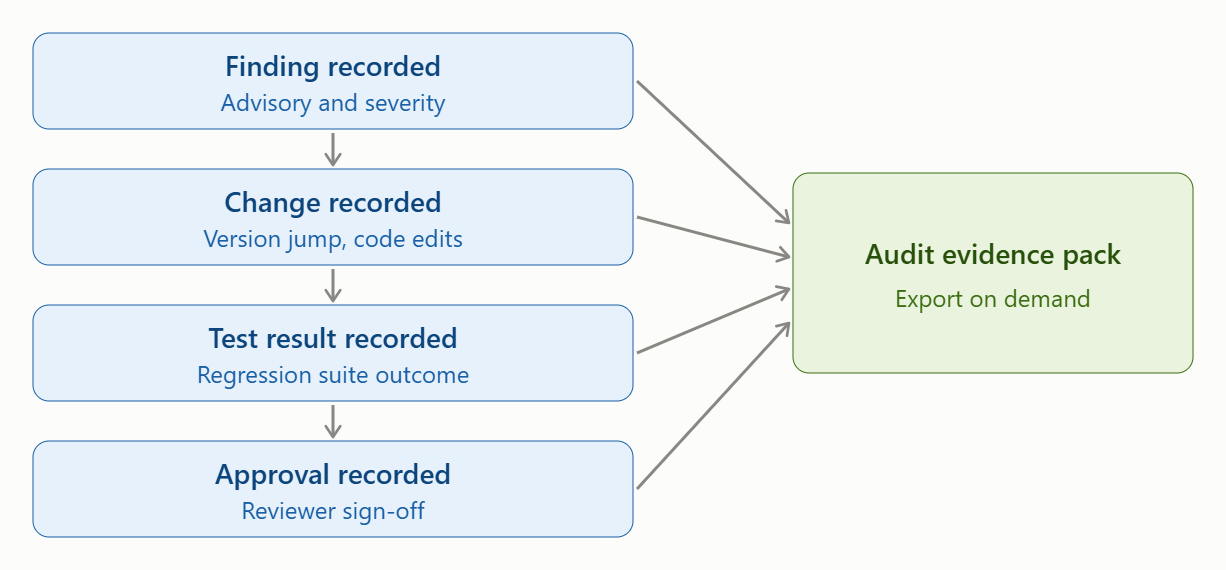
Audit Evidence for Every Change
Strong audit evidence captures what was found, what changed, and what was verified. Timestamps connect each stage. Consequently, compliance teams stop assembling screenshots before an audit.
Instead, they export a ready trail. Continuous runs also matter more than a single clean scan, because auditors look for controls that operate consistently across the whole audit period.
What Should Engineering Leaders Check Before Automating Fixes?
Automation needs guardrails. Before adopting any tool, verify four things:
- Dry-run mode: preview every change before any code is touched.
- Human approval: reviewers sign off on fixes wherever policy requires it.
- Test coverage: existing tests must be strong enough to catch regressions.
- Rollback path: every change must be reversible, with a clear history.
Importantly, start with one low-risk repository, then widen the scope. This builds trust gradually and exposes coverage gaps early. Dependency security improves most when teams treat remediation as a recurring practice, not a one-time cleanup.
Where Does Xccelera Fit in Your Remediation Workflow?
Xccelera builds AI-native engineering systems for enterprises that need to move faster without lowering their security standards.
Its AI security and vulnerability auto-resolution capability finds vulnerable and outdated dependencies, upgrades them, remediates the affected code, and tests every fix before it ships.
Each scan, upgrade, and change is recorded, so engineering and compliance teams share one trusted trail. Human approval stays in the loop wherever policy requires it, which keeps control with your people while agents handle the repetitive work.
For CTOs and VPs of Engineering, that means a shorter security backlog, faster remediation, and audit evidence that builds itself. Xccelera helps organizations resolve vulnerabilities rather than simply report them, so security becomes part of everyday delivery instead of a recurring emergency.
\
About the author
- Xccelera is an AI-first transformation company delivering advanced Agentic AI Services and scalable AI Solutions designed to help enterprises & SMBs to automate work, accelerate decision-making, and modernize operations with autonomous intelligence. We build, deploy and maintain production-ready AI Agents that function as digital workers capable of executing tasks, collaborating across systems, and adapting to real-world conditions. Businesses can integrate our agents into existing workflows or adopt them directly for immediate impact. Each agent is engineered for accuracy, speed, and enterprise reliability, empowering organizations to reduce operational effort, increase productivity, and scale intelligently in a fast-changing digital environment.
Comments
Join the discussionNo comments yet. Be the first to comment.