
Access Controls for AI Agents in Production Code Repositories
A coding agent opens a pull request at 2 a.m. and merges it before anyone wakes up. The change looks routine, yet the agent held write access to every branch it could reach. Teams drafting AI agent access control code repositories often copy their human role model and hope it fits. It rarely does. Agents now work as real contributors, so they need real boundaries. This guide covers how to scope permissions, gate risky actions, and record every change. It is written for engineers and technical leaders who must defend those decisions in a security review.
Why Does AI Agent Access Control for Code Repositories Need Its Own Model?
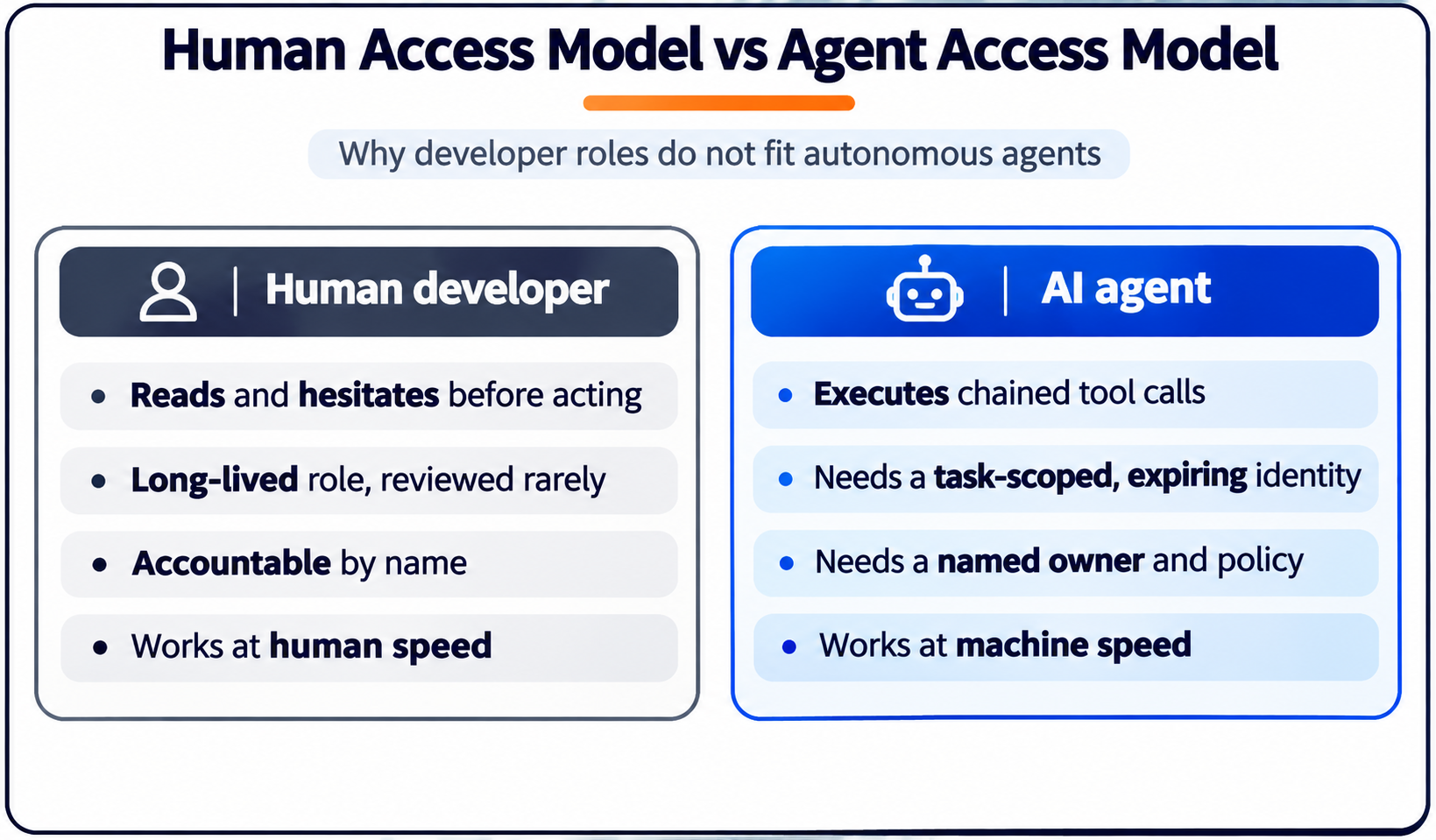
Human permission models assume a person who reads, hesitates, and answers for outcomes. Agents do none of that. They execute at machine speed, chain tool calls, and follow instructions buried in files they read.
Most AI agent access control code repositories guidance still maps agents onto developer roles. That hands them far more reach than any single task needs.
The numbers show how common this is. Lead Dev's 2026 survey found that 81% of teams give agents write access to repositories, while only 7% keep them read-only.
OWASP names the resulting pattern Excessive Agency (LLM06) in its 2025 Top 10 for LLM Applications. The fix starts with treating the agent as its own identity, with its own scope, owner, and expiry. Every other control in this guide builds on that single decision.
What Does Least Privilege Look Like for AI Coding Agents?
Least privilege for AI agents means each task receives only the access it needs, for only as long as it needs it. Well-designed AI coding agent permissions rest on two controls.
Scoped Access Tokens and Short-Lived Credentials
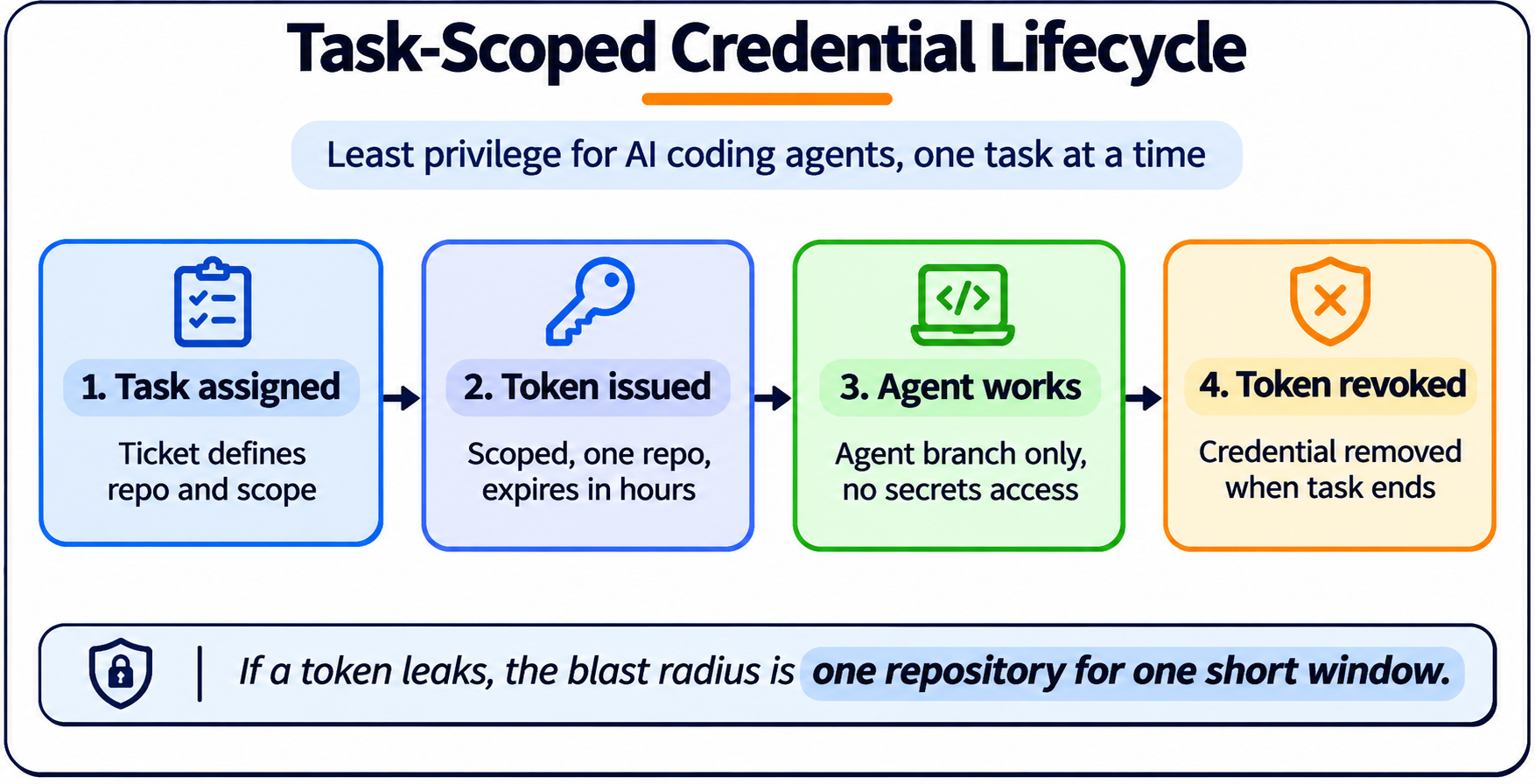
Issue a dedicated identity per agent, never a shared developer token. Use fine-grained, scoped access tokens limited to one repository and the permissions a task requires, such as read-only contents access plus write access to pull requests. Set expiry in hours, not months.
A documentation agent should never reach deployment workflows or secrets. Store credentials in a vault and inject them at runtime, so they never enter prompts, logs, or config files. Revoke the token the moment the task finishes. If a token leaks, the blast radius is one repository for one short window.
Branch Protection and Allowed Write Paths
UpGuard's February 2026 analysis of more than 18,000 public agent configuration files found that about one in five let agents commit straight to the main branch.
Branch protection for AI agents removes that option. Require pull requests, passing status checks, and at least one human review on protected branches. Block force pushes and branch deletions.
Use CODEOWNERS to route changes to CI workflows, infrastructure code, and authentication modules toward named reviewers. Confine the agent to a working branch prefix such as agent/, so every change arrives as a reviewable diff instead of a silent commit.
How Do You Add Human-in-the-Loop Approval Without Slowing Delivery?
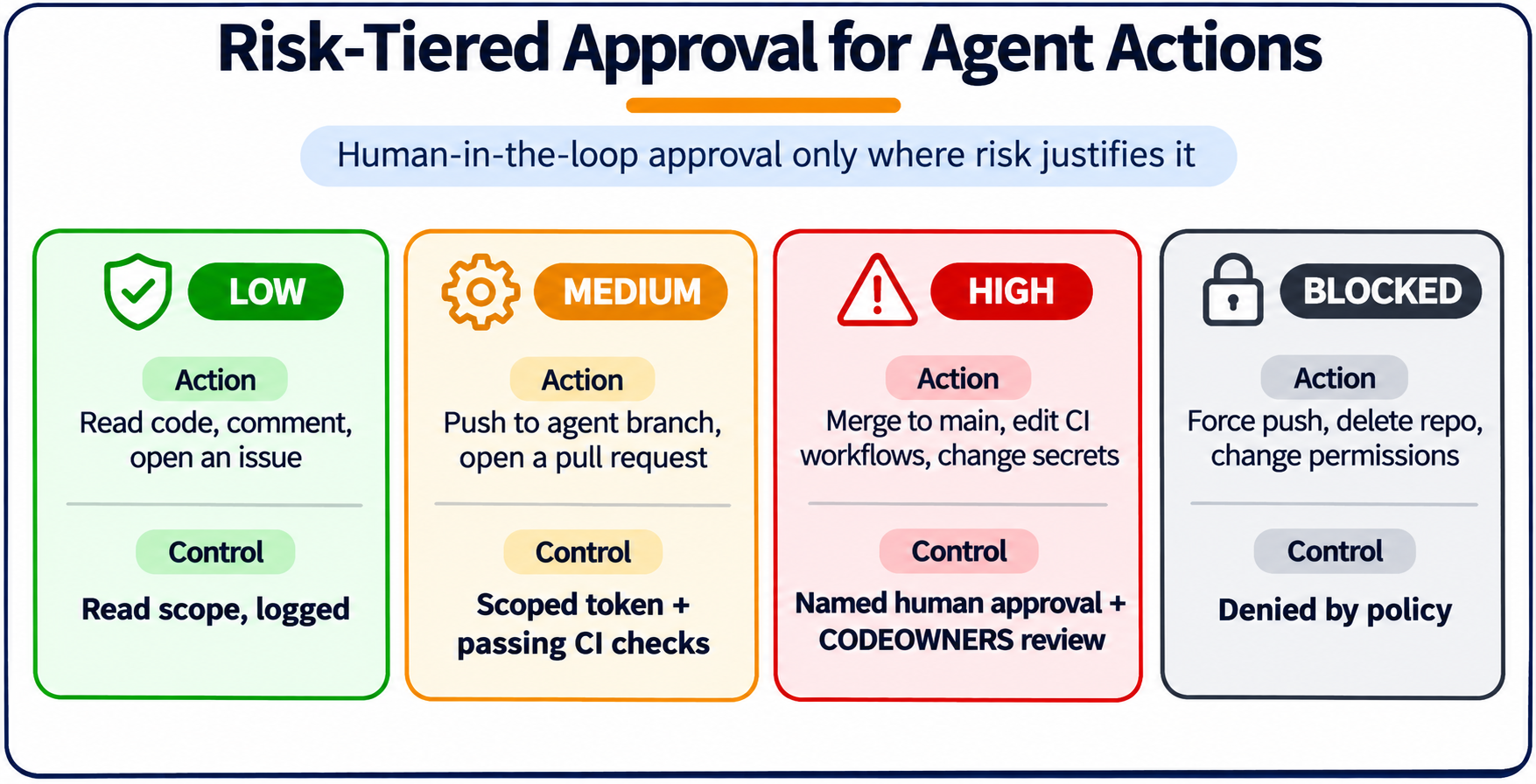
Approval on every action destroys the value of automation. Approval on none invites incidents. The workable middle is tiered by risk: low-risk actions run on their own, medium-risk actions need automated checks, and high-risk actions need a named human. Role-based access control still helps, but roles attach to the agent identity and the action tier, not to a job title.
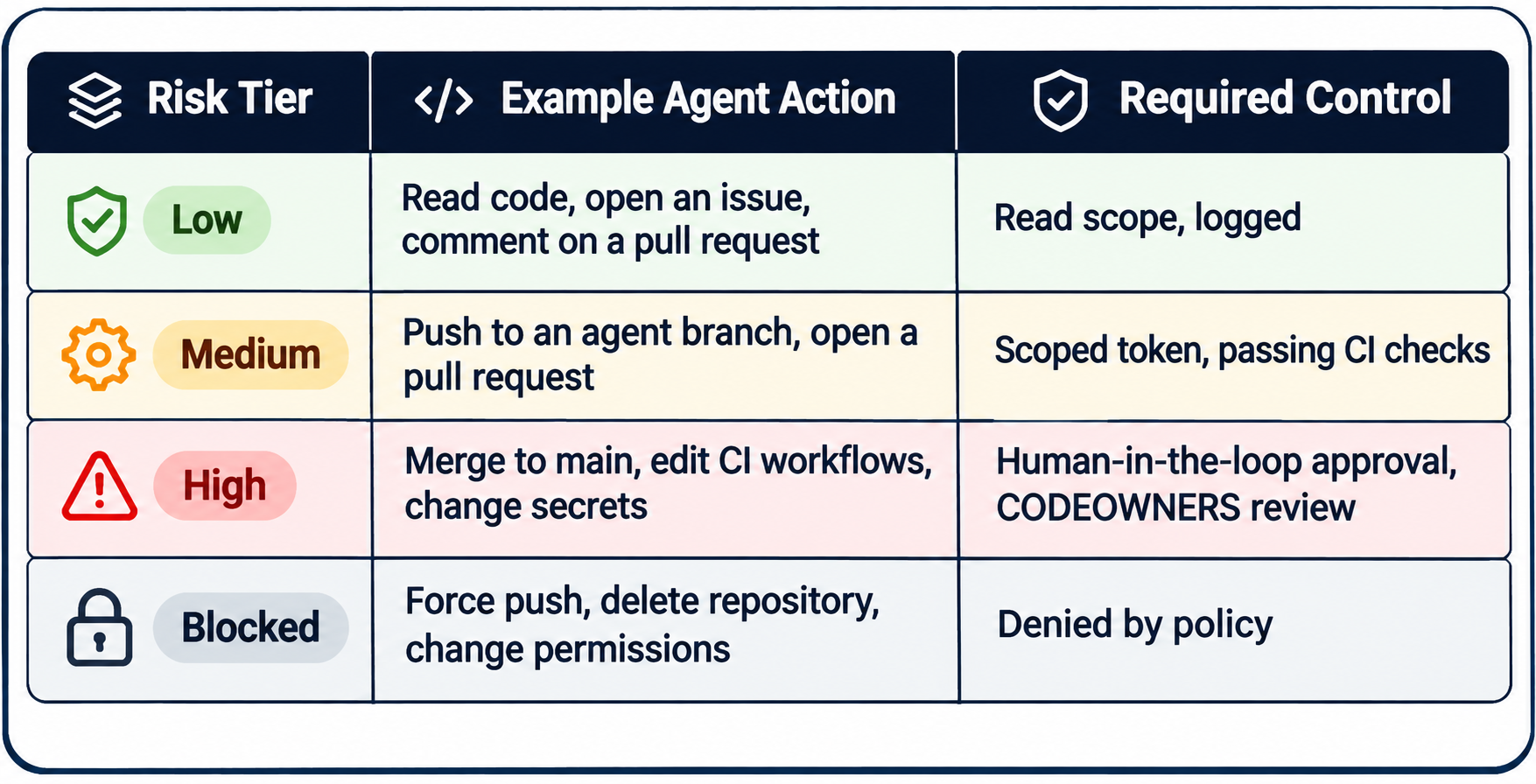
Keep approval queues short by batching related changes into one pull request. Reviewers should see the diff, the test results, and the agent's stated reason together. That keeps human-in-the-loop approval fast enough that teams do not route around it.
How Should You Build an AI Agent Audit Trail for Repository Changes?
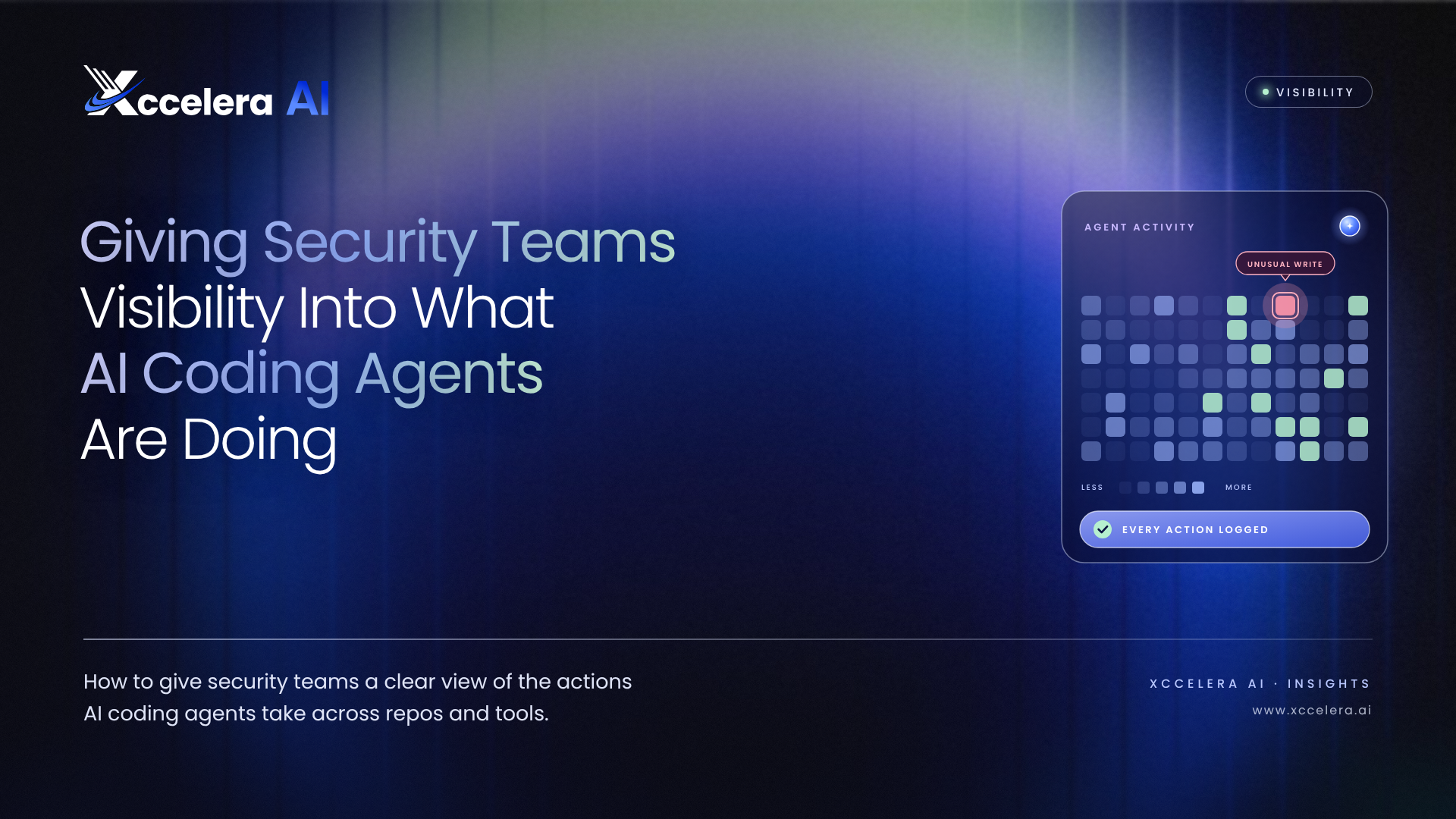
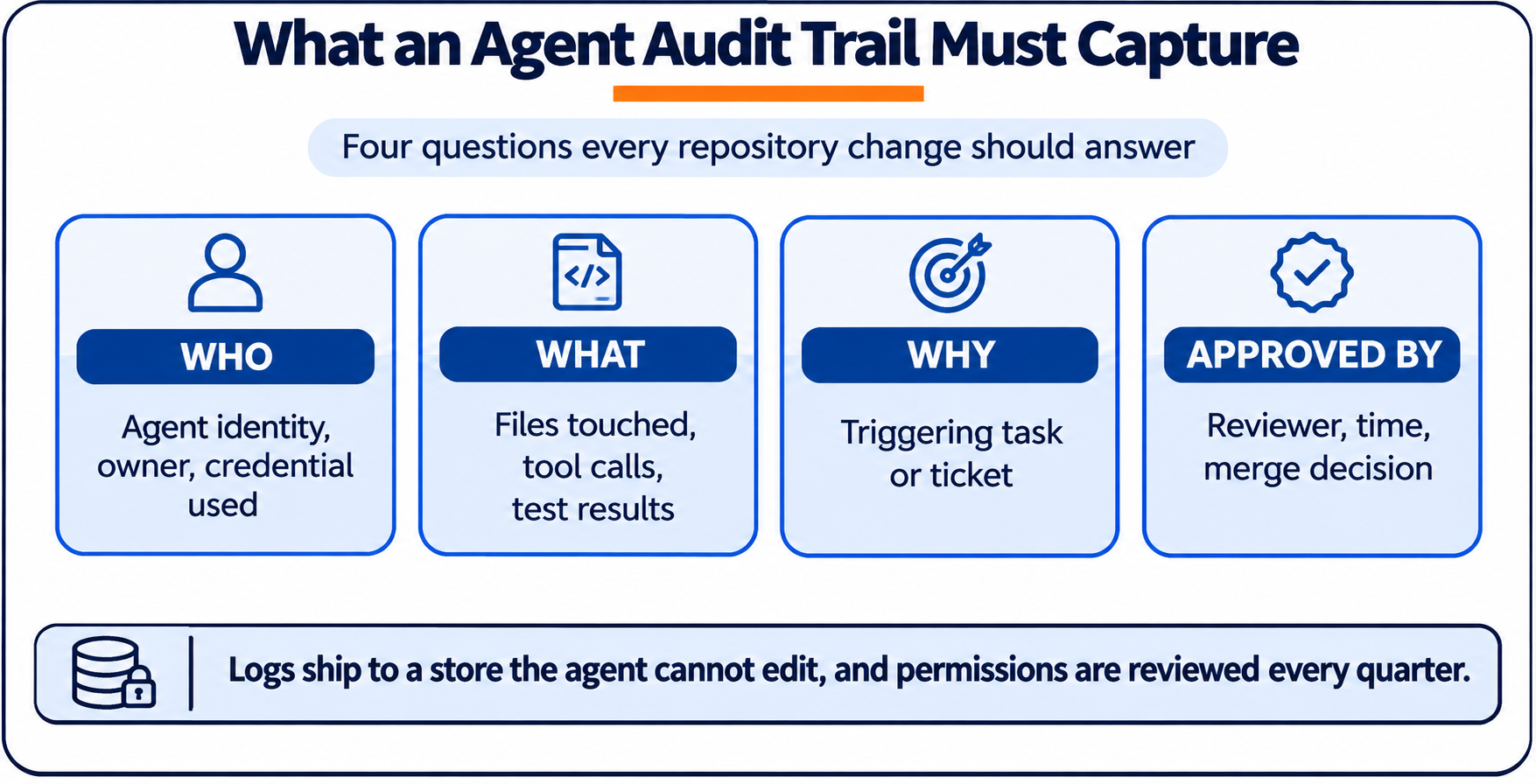
An AI agent audit trail answers four questions after any change: who acted, what changed, why it changed, and who approved it. Log the agent identity, the triggering task or ticket, every file touched, each tool call, and the test results.
Tag or sign commits so agent-authored work is always identifiable in history. Ship logs to a store the agent cannot edit, because a compromised agent should not be able to erase its own tracks.
Review matters as much as logging. In 1Password's 2026 survey, agents reached roughly twice as much data as anyone had approved.
Review agent permissions every quarter, and remove any access nobody can justify. Auditors and incident responders will both ask for this record, and rebuilding it afterward is slow and unreliable.
Which Access Risks Appear When Agents Touch Dependencies and Security Fixes?
Dependency updates test agent access harder than any other workload. An upgrade agent edits manifests, lockfiles, and application code, then triggers builds. That needs write access across many files, so scope and review matter even more. Security fixes add urgency, which tempts teams to skip approval.
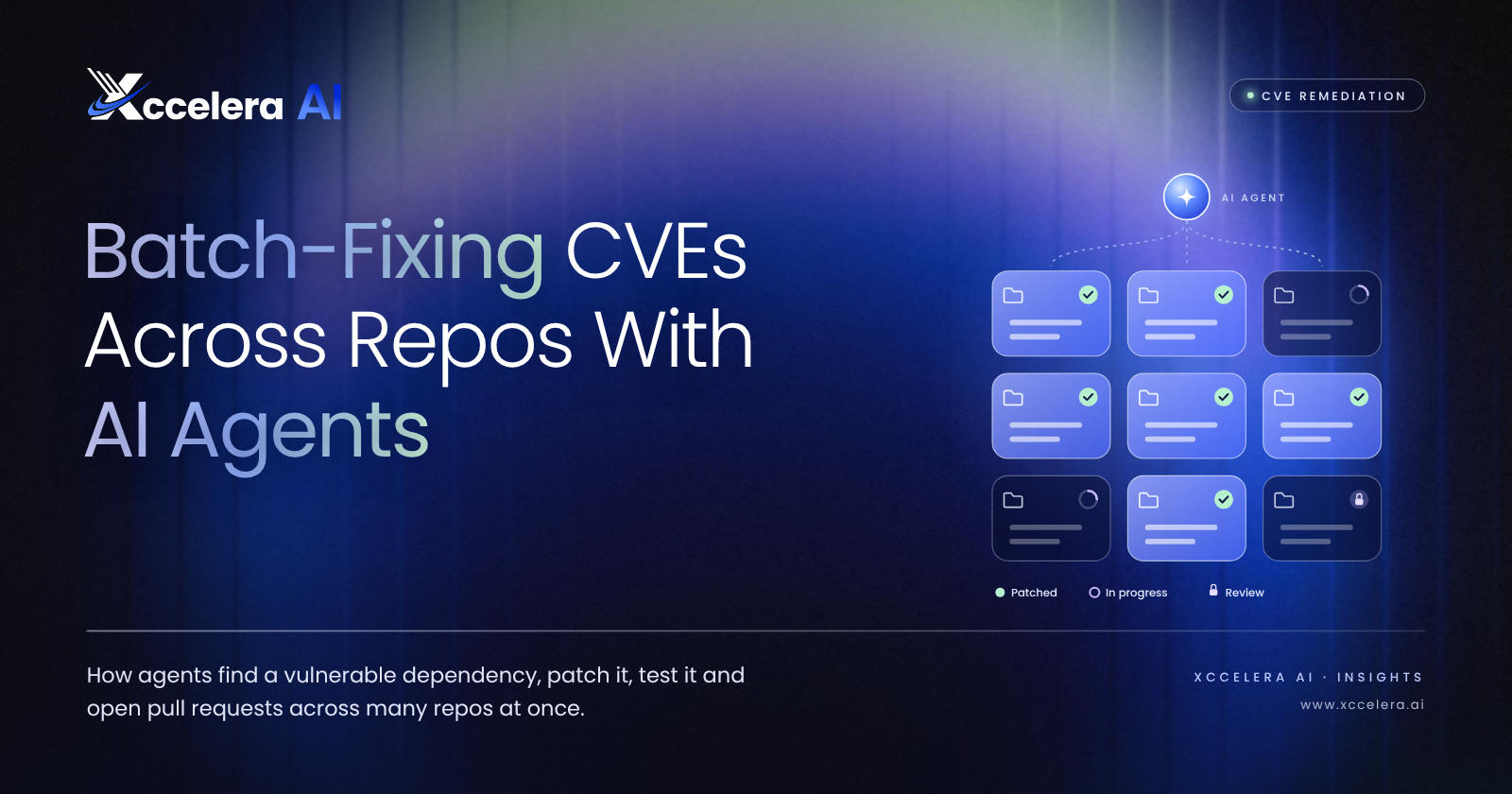
The safer pattern keeps the agent on its own branch, runs the full regression suite, and delivers a pull request with evidence attached. That is the model behind closing the CVE-to-fix gap automatically without handing an agent unchecked merge rights.
Automated vulnerability remediation should follow the same rules as every other agent: scoped identity, protected branches, human approval for merges, and a complete record.
An AI security dependency upgrader and vulnerability auto-resolver can run inside those guardrails, so dependency security improves without widening the access surface. Treat every upgrade as a high-risk change until its tests pass.
Governed AI Engineering With Xccelera
Agent access control is a design decision, not a cleanup task. Teams that scope identities, protect branches, tier approvals, and keep durable records ship faster, because security reviews stop being surprises.
Xccelera builds its AI engineering capabilities around that principle. Its agents work inside boundaries your organization defines, route sensitive changes to human reviewers, and record what was found, changed, and verified, so every automated change can be defended in an audit.
For CTOs and engineering leaders, the goal is simple: let AI agents do real work in production repositories while authority, accountability, and evidence stay with your team. Start by writing down what each agent may touch, then enforce that list in tooling.
About the author
- Xccelera is an AI-first transformation company delivering advanced Agentic AI Services and scalable AI Solutions designed to help enterprises & SMBs to automate work, accelerate decision-making, and modernize operations with autonomous intelligence. We build, deploy and maintain production-ready AI Agents that function as digital workers capable of executing tasks, collaborating across systems, and adapting to real-world conditions. Businesses can integrate our agents into existing workflows or adopt them directly for immediate impact. Each agent is engineered for accuracy, speed, and enterprise reliability, empowering organizations to reduce operational effort, increase productivity, and scale intelligently in a fast-changing digital environment.
Comments
Join the discussionNo comments yet. Be the first to comment.