
Multi-Agent Systems for Enterprises: Architecture Patterns That Work
Most multi-agent programs stall on coordination, not model quality. Enterprise teams that pick a clear pattern, define agent roles, control shared context, and build governance into orchestration reach production faster and with fewer surprises. Supervisor, pipeline, and peer designs suit different workloads, and the right choice depends on risk, dependency depth, and audit needs. Strong multi-agent systems for enterprises treat every hand-off as a contract and make every agent action visible to the people accountable for it.
Multi Agent Systems for Enterprises Fail at the Coordination Layer, Not the Model Layer
Teams rarely lose a multi-agent project because an agent writes poor output. They lose it because two agents disagree about state, a hand-off drops context, or nobody can say which agent made a decision. Models improved quickly. The wiring between them did not.
Multi agent systems for enterprises succeed or fail on the questions distributed systems engineers have asked for decades: who owns the task, who holds the state, and what happens when a step fails.
A single capable agent hides weak architecture. Five agents expose it within a week.
Pattern choice, role boundaries, and context rules matter more than the model inside each box.
Multi-Agent Architecture Patterns Compared: Supervisor, Pipeline, and Peer Models
Enterprise multi-agent architecture usually settles into one of three shapes, and many production systems blend them. The best multi-agent AI systems pick a dominant pattern per workflow instead of forcing one design everywhere. Each pattern trades control against flexibility.
The table below frames those trade-offs, and the three subsections explain where each pattern earns its place and where it starts to hurt. Choosing well early saves months of rework, because changing a coordination pattern after launch means rewriting every hand-off in the system.
Pattern | Control | Typical failure mode | Best fit |
Supervisor | High, central | Bottleneck at the coordinator | Regulated, audit-heavy workflows |
Pipeline | Medium, sequential | Errors travel downstream | Repeatable delivery stages |
Peer | Low, distributed | Message loops and drift | Exploratory, loosely coupled tasks |
Supervisor Pattern Trade-Offs for Enterprise Workloads
One coordinating agent breaks a goal into tasks, assigns them to specialists, and checks each result before moving on. Auditors like this design because one place holds the decision trail. The cost is a bottleneck and a single point of failure. Teams reduce both by keeping the supervisor thin:
- Route and verify, but never do the specialist work itself.
- Set time and retry limits on every assignment.
- Log each delegation with its reason and outcome.
Pipeline Pattern Trade-Offs for Sequential Delivery
A pipeline passes work through a fixed order, so each agent transforms the output of the one before it. Behavior stays predictable and monitoring stays simple, which suits stages such as build, test, and release. The weakness is error propagation. A flawed output at stage two quietly corrupts stages three through five. Place a validation gate between stages so a bad hand-off stops the line instead of traveling downstream, and keep stage order configurable rather than hard-coded.
Peer Coordination Trade-Offs at Scale
Peer designs let agents message each other directly, which makes them flexible and resilient when no single agent understands the whole task. They also create the hardest systems to audit. Without limits, agents loop, repeat work, or drift from the original goal. Cap the number of message rounds, require a named owner for every open task, and record the full message trail. Most enterprises should confine peer coordination to bounded, low-risk problems and run high-stakes work through a supervisor.
Agent Role Specialization and Hand-Off Design in Enterprise Multi-Agent AI Systems
Agent role specialization lowers prompt sprawl and makes each agent easier to test, because a narrow agent has a narrow definition of correct. Overlapping roles do the opposite, producing duplicate work and conflicting outputs. Specialization only pays off when hand-offs are explicit. Every hand-off between agents should carry five items:
- The task goal and its acceptance criteria.
- Input data with source references.
- Constraints and permissions for the receiving agent.
- The expected output format.
- A clear trigger for escalating to a human or the supervisor.
Treat shared context and hand-offs as an interface contract. If the contract is vague, the receiving agent fills the gap with guesses.
Shared Context and State Management Across Enterprise AI Agent Coordination
Enterprise AI agent coordination breaks down when agents work from different versions of the truth. One agent updates a requirement while another builds against the old one, and the conflict surfaces only at integration.
A coordination design needs a clear answer for what each agent can read, what it can write, and who resolves conflicts. Without those rules, debugging becomes archaeology.
Teams building multi agent systems for enterprises feel this first, since more agents mean more places for state to diverge, and each divergence costs engineering time to trace.
Context Boundaries Between Agents
Give each agent the minimum context its role needs, and keep one authoritative store for shared state. Small, typed contracts beat free-form text passed between agents. A simple example:
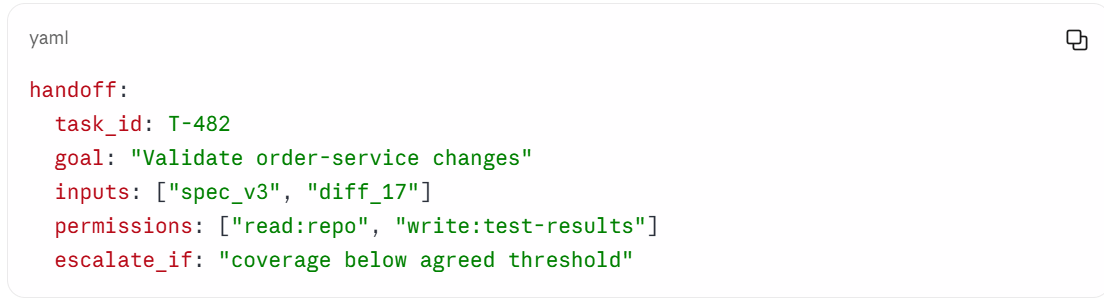
Narrow permissions also limit the damage when one agent misbehaves. The contract above names the task, the inputs, the access the agent holds, and the condition that sends work back to a person, so a reviewer can read one block and understand the whole hand-off.
Failure Handling and Recovery Paths
Plan for failure before the first deployment, because multi-step workflows fail in the middle. Decide in advance what each failure does:
- Retry when the error is transient and the step is safe to repeat.
- Roll back when a partial result would leave systems inconsistent.
- Escalate when the agent lacks authority or confidence to proceed.
- Halt when downstream steps depend on a result that failed validation.
Record the chosen path with the failure so the next incident starts with evidence instead of guesswork.
Agent Orchestration Patterns That Hold Up Under Governance and Audit Pressure
Governance gets harder to add after a system is running, so it belongs inside the orchestration layer from the start. Agent orchestration patterns hold up under audit when four properties are built in:
- Traceability: every agent action links to a task, an owner, and an outcome.
- Approval points: designated steps pause for human sign-off before irreversible actions.
- Scoped authority: each agent acts only within its assigned permissions.
- Reproducibility: a reviewer can reconstruct why a decision was made.
Boards and risk teams ask for these properties first. Teams that design them in early rarely face a rebuild when scrutiny arrives.
Xccelera AI and the Path to Production Multi Agent Systems for Enterprises
Production multi agent systems for enterprises need more than a good pattern on a diagram. They need specialized agents that run in parallel without colliding, human-in-the-loop controls where judgment matters, and monitoring that tracks each agent and what it delivers.
Xccelera AI builds around that need with a multi-agent platform where specialized agents work across backend development, frontend development, integration, validation, unit testing, and deployment.
Enterprise AI governance and scaling frameworks sit alongside it, so teams can build, deploy, govern, and scale agent systems with oversight intact, moving from first concept to enterprise-wide use without losing control along the way.
For technical leaders, the practical test is simple: can the organization see, steer, and explain every agent action as the system grows?
\
\
About the author
- Xccelera is an AI-first transformation company delivering advanced Agentic AI Services and scalable AI Solutions designed to help enterprises & SMBs to automate work, accelerate decision-making, and modernize operations with autonomous intelligence. We build, deploy and maintain production-ready AI Agents that function as digital workers capable of executing tasks, collaborating across systems, and adapting to real-world conditions. Businesses can integrate our agents into existing workflows or adopt them directly for immediate impact. Each agent is engineered for accuracy, speed, and enterprise reliability, empowering organizations to reduce operational effort, increase productivity, and scale intelligently in a fast-changing digital environment.