
Multi-Agent Orchestration Patterns: Supervisor, Swarm, and Pipeline
Supervisor, swarm, and pipeline designs solve different coordination problems.
A supervisor gives one agent control and a clear audit trail. A swarm lets peer agents route work among themselves and adapt fast. A pipeline chains specialists in a fixed order for predictable results.
Each choice trades control, speed, and failure tolerance.
Teams that match the pattern to the workflow avoid hidden cost, stalled hand-offs, and runs nobody can trace.
The right pattern also decides how a person steps in when an agent gets stuck.
Multi-Agent Orchestration Patterns That Decide Whether Enterprise Multi-Agent Systems Scale or Stall
Most multi-agent failures are not model failures. They are coordination failures.
One agent waits on a result that never arrives. Two agents edit the same file. A manager keeps retrying a task no worker can finish.
These problems come from structure, not from prompts.
Multi-agent orchestration patterns give that structure a name, so teams can pick one on purpose.
Three patterns cover most enterprise work: supervisor, swarm, and pipeline.
Each handles agent coordination, task routing, and agent hand-offs in its own way.
Teams that treat orchestration as the enterprise control plane for multi-agent orchestration settle these tradeoffs before the first agent ships.
Supervisor Agent Pattern: Central Control, Audit Trails, and the Single Point of Failure Tradeoff
Among multi-agent orchestration patterns, the supervisor design is the easiest to explain to an auditor.
One agent owns the plan. It reads the request, splits it into tasks, sends each task to a specialist worker, and checks what comes back.
Workers never talk to each other, so every decision passes through one place.
That clarity is why regulated teams start here.
The cost is concentration. The supervisor sees every message, so its context fills fast, and if it fails, the whole run stops.
Approval Gates, Retry Budgets, and Worker Boundaries That Keep a Supervisor From Becoming a Bottleneck
Three controls keep this design healthy:
Approval gates: The supervisor pauses before writing to a system of record. A person approves or rejects, a choice explored in human-in-the-loop versus fully autonomous workflow models.
Retry budgets: Cap retries for each task, then escalate. Unbounded retries let one stuck worker burn a day of compute.
Worker boundaries: Give each worker a short tool list and a fixed output format, so the supervisor never parses free text to pick the next step.
Use a supervisor when audit and control matter more than raw speed.
Swarm Architecture for AI Agents: Decentralized Agent Coordination and Its Operational Cost
A swarm has no boss.
Peer agents share one pool of state and pass work to whichever agent fits next. Any agent can claim a task, split it, or hand it on.
This swarm architecture for AI agents adapts well when the work cannot be planned up front, such as incident triage or open research.
It also removes the single point of failure, since no one agent holds the plan.
Among multi-agent orchestration patterns, it is the hardest to observe.
With no central record of intent, you must rebuild a run from many local choices, and agents may repeat each other's work.
Shared State, Loop Guards, and Trace Design That Make Decentralized Agents Safe to Run in Production
Freedom needs fences.
Four controls matter most:
Shared state: Keep one versioned task board. Agents read it before they act and write to it after.
Loop guards: Set a hop limit and a repeat check, so two agents cannot pass a task back and forth forever.
Trace identifiers: Stamp every action with a run identifier and a parent identifier, so the full path can be rebuilt later.
Spend caps: Give each run a token and tool budget that no agent can raise.
Swarms suit exploratory work. They fit poorly where a regulator expects a clear chain of decisions.
Pipeline Orchestration for AI Agents: Sequential Agent Hand-Offs and Task Routing Breakpoints
Pipeline orchestration for AI agents chains specialists in a fixed order.
One agent drafts, the next validates, and a third packages the result.
Microsoft's architecture guidance describes this sequential pattern as agents chained in a predefined, linear order.
Google Cloud's design guidance notes that it can cut latency and cost compared with letting a model pick the route.
That predictability is the strength of multi-agent orchestration patterns built this way.
Testing is simple, since each stage has one input and one output.
The weakness is rigidity. A bad output at stage two flows into every later stage.
Typed Hand-Off Contracts and Stage Gates That Stop One Bad Output From Poisoning Every Later Stage
Most pipeline failures hide in the seams between stages.
A short checklist helps:
Typed contracts: Define the exact fields each stage must return, and reject anything that does not match.
Stage gates: Run a validation check after each stage, not only at the end.
Repeatable steps: Make every stage safe to rerun, so a retry never doubles a side effect.
Parking queue: Move failed items aside for review instead of blocking the whole line.
Pipelines fit repeatable work such as document processing, code checks, and report assembly.
Teams that outgrow one pipeline can study how enterprises coordinate workflows without losing control.
Multi-Agent Orchestration Architecture Selection Matrix for Latency, Control, and Failure Tolerance
Choosing among these multi-agent orchestration patterns comes down to four questions:
How predictable is the work?
How much audit control does the business need?
How much delay can the user accept?
What should happen when one agent fails?
The matrix below turns those questions into a first pass.
Real enterprise multi-agent systems often mix patterns, such as a supervisor that runs a pipeline for each routine task.
Treat the matrix as input to a design review, not a final answer.
Side-by-Side Comparison of Supervisor, Swarm, and Pipeline Designs Across Six Design Dimensions
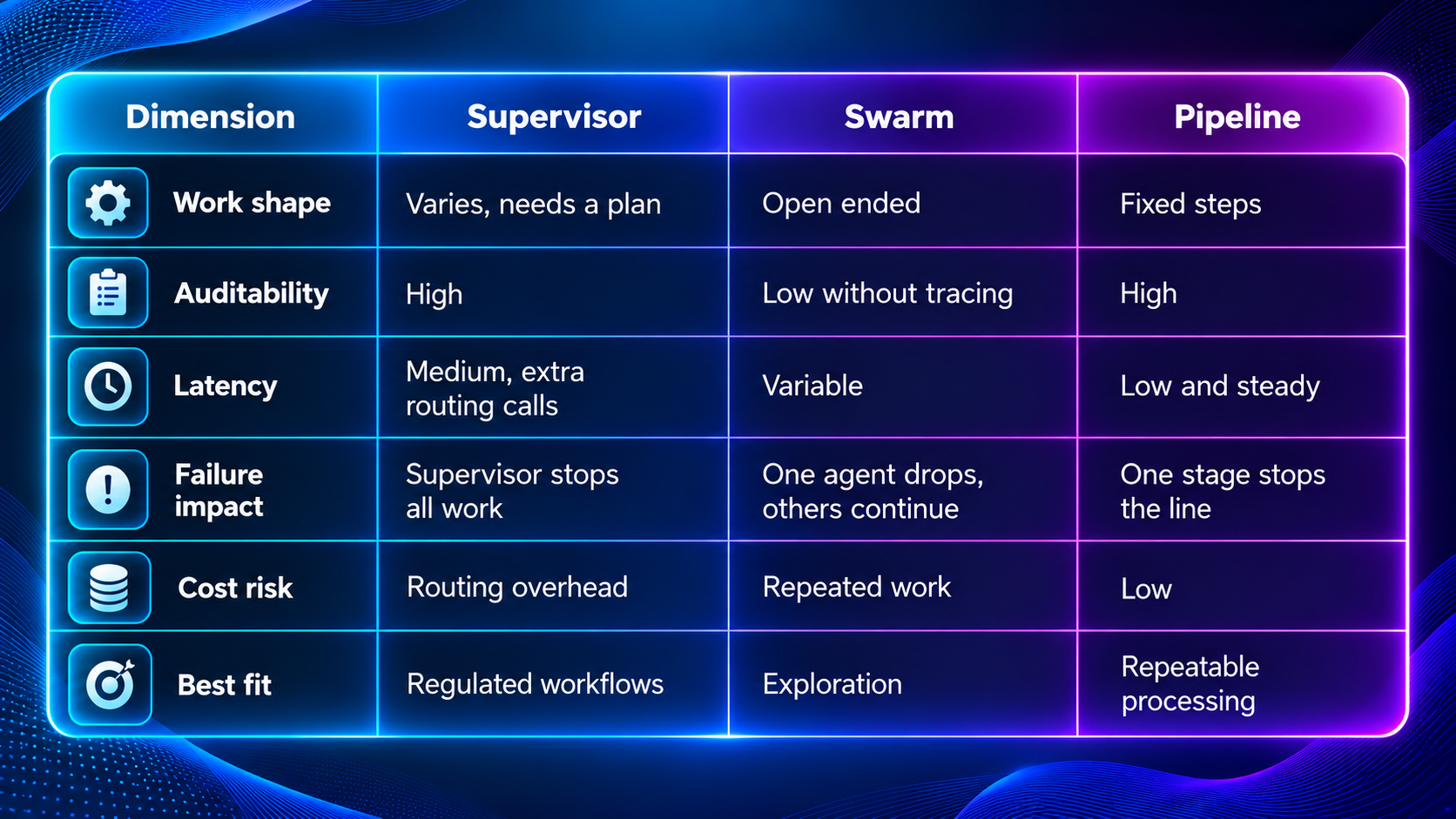
Microsoft's guidance urges teams to use the lowest complexity that reliably meets the need.
Start with the simplest pattern, then add coordination only when a measured limit appears.
Multi-Agent Orchestration Patterns With Xccelera: Parallel, Governed Execution for Enterprise Multi-Agent Systems
Choosing a pattern is only half the job.
Enterprises also need agents that work in parallel, stay observable, and stop for a person when the stakes rise.
Xccelera AI offers a proprietary multi-agent platform where purpose-built agents plan, reason, and execute workflows across backend development, frontend development, integration, validation, unit testing, and deployment.
Specialized agents run parallel tracks, and each agent and its deliverables are tracked at every step, with human-in-the-loop controls throughout.
For leaders weighing supervisor, swarm, or pipeline designs, that combination turns an architecture decision into governed delivery from concept to scale.