
AI-assisted code migration succeeds or fails on how well a team understands what a legacy system depends on. Hidden links between modules, data stores, and runtime services turn a clean conversion plan into production incidents.
A disciplined legacy dependency mapping practice gives engineering leaders a verified picture of coupling, a defensible migration sequence, and clear checkpoints for human review before any code is converted. The outcome is lower migration risk and fewer surprises late in delivery.
AI-Assisted Code Migration Fails Before the First Line Is Converted
Most migration plans begin with the target stack and a conversion backlog. The failure begins earlier. A legacy system is a web of obligations, and the web is rarely documented.
When an AI model converts a module without knowing what it calls, what it calls, and which database tables it quietly shares, the output compiles and still breaks production behavior.
That gap explains why legacy code modernization programs run long. BCG noted in June 2025 that modernization projects can take two to four times longer than initially estimated, and that hidden issues surfacing late in the process drive delays and cost overruns. Teams that adopt an enterprise agentic AI platform still need a verified map of what the system touches before agents convert anything.
Treat AI-assisted code migration as two problems. The first is comprehension: what exists and how it connects. The second is transformation: converting it safely. Most budgets fund the second and assume the first.
Building a Legacy Dependency Mapping Practice Across Code, Data, and Runtime
A useful dependency map covers three layers, and each layer needs its own detection method. Static analysis finds what the code declares. Runtime observation finds what the system actually does. Data and integration review finds what lives outside the repository.
MITRE's 2025 research found that large language models can generate intermediate representations from legacy code at scale, yet recommends highly supervised use on mission-critical systems. The same logic applies here: AI drafts the map, and engineers verify it before anyone relies on it.
Static Dependencies and Transitive Dependencies
Start with imports, includes, copybooks, build files, and package manifests. Static analysis produces the first graph quickly, and AI models help by explaining unfamiliar legacy syntax.
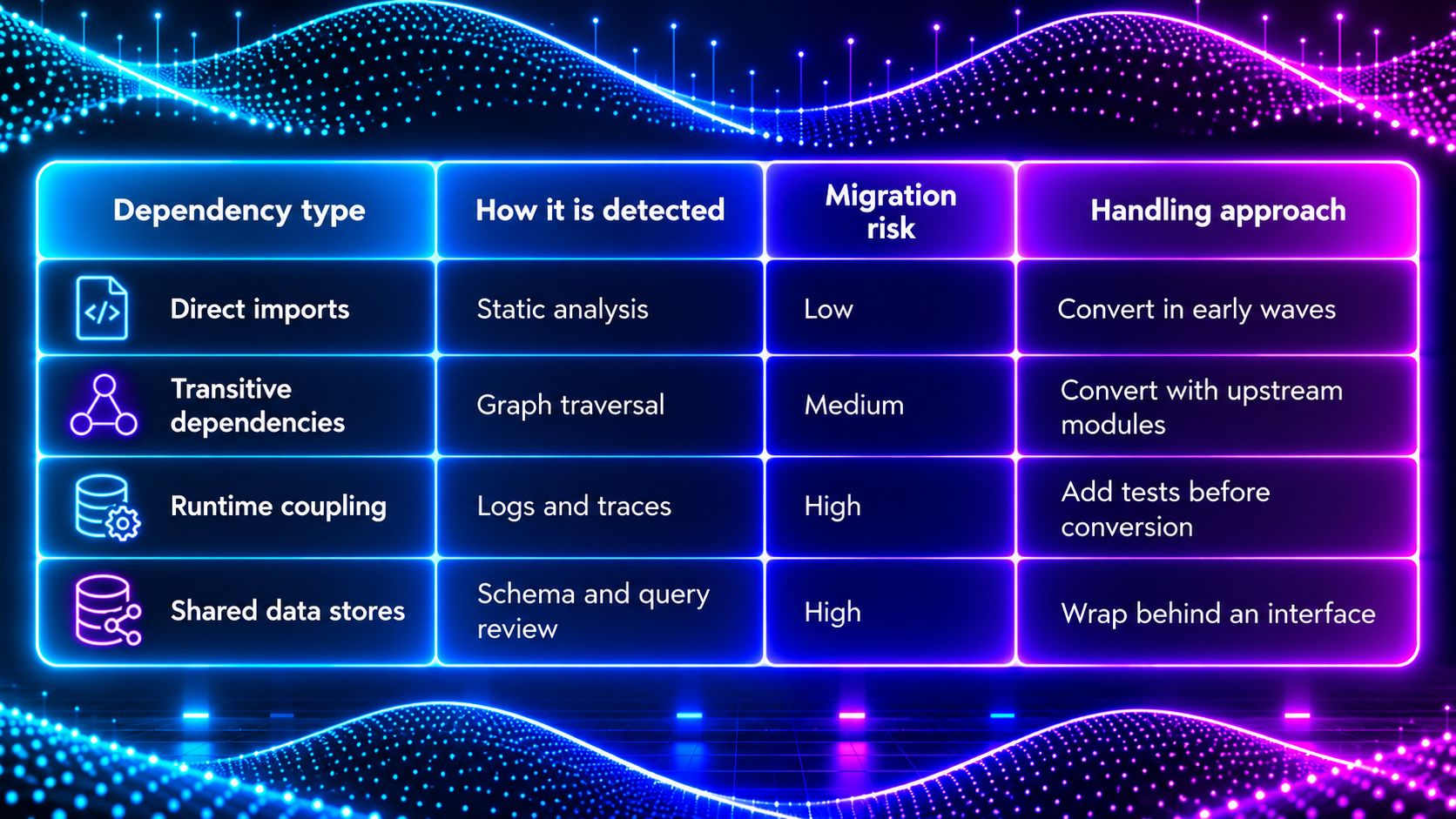
The harder work is transitive dependencies. A module that looks isolated may reach a shared library three hops away. Record every edge with its direction and its source, so reviewers can trace any claim back to a file and a line.
- Direct calls and imports
- Shared libraries and copybooks
- Build and packaging links
- Version pins that block upgrades
This first pass is cheap and fast, which makes it tempting to stop here. Resist that. It shows what the code says, and that is only one third of the picture.
Runtime Coupling That Static Analysis Misses
Some links never appear in source files. Runtime coupling hides in configuration-driven routing, scheduled jobs, message queues, reflection, and feature flags.
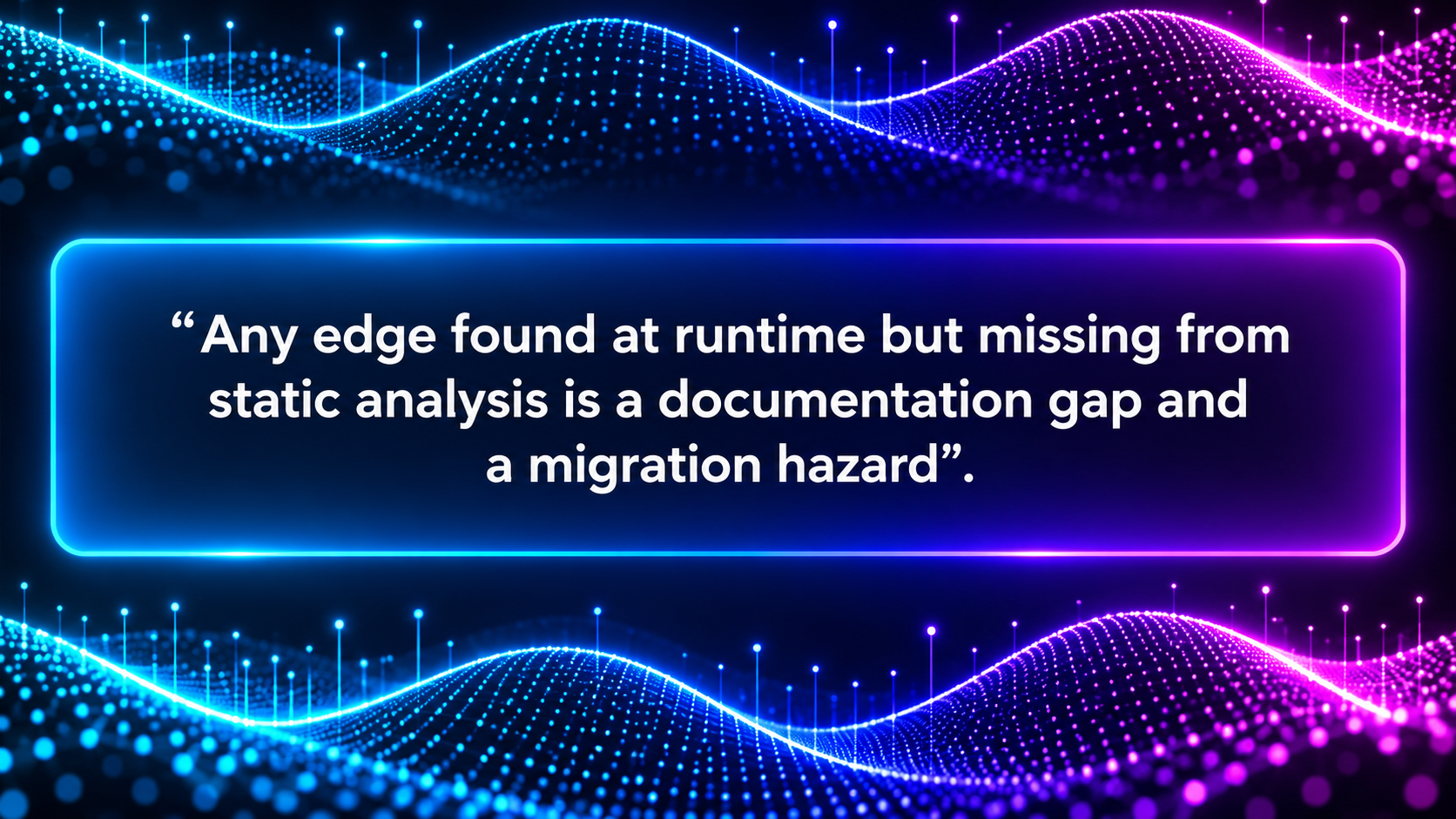
A module can look unused in the repository and still run every night at 2 a.m. Capture this layer from logs, traces, and job schedulers, then compare it against the static graph.
Even a few weeks of production traces often expose links that years of documentation never captured.
Data and Integration Dependencies
Databases often carry more coupling than code does. Shared tables, stored procedures, file drops, batch windows, and calls to external services bind systems together. Each one constrains what can move first.
List them alongside code edges so the sequence reflects the real system, not just the repository.
Also note ownership: a table written by three teams needs three approvals before it moves, and that fact changes the schedule as much as any technical constraint.
Treat batch windows the same way, because a migrated job that overruns its window can stall every downstream report.
From Dependency Graph Analysis to Migration Sequence
Once the map exists, dependency graph analysis turns it into a sequence. Modules with few inbound edges move first because they carry the least blast radius. Shared hubs move last, or get wrapped behind a stable interface so old and new code can run side by side.
Each wave ends with a human review gate where engineers confirm that behavior matches the legacy system. The table below shows how each dependency type changes the plan.
Engineering Tradeoffs and Migration Risk in Legacy Dependency Mapping
No map is complete, and pretending otherwise is the costliest mistake. Every mapping approach trades speed against confidence. Fast automated passes cover large codebases but miss dynamic behavior.
Deep manual review catches subtle links but does not scale. Leaders should decide how much uncertainty each wave can absorb and name who signs off on the rest.
- Stale documentation: Old diagrams describe the system as designed, not as running. Treat them as hints, never as evidence.
- Undocumented business logic: Rules buried in conditionals need subject matter experts, not only models.
- Map drift: Code keeps changing during migration. Refresh the graph at each wave.
- Over-trusted output: A confident AI summary can hide a missing edge. Require evidence for every claimed link.
Where Xccelera Fits in Legacy-to-Modern Code Migration
Enterprises rarely lack the will to modernize. They lack confidence that conversion will preserve behavior. Xccelera AI addresses that gap with a platform that supports modernization and migration of legacy codebases and applications, governed by human-in-the-loop controls throughout.
Its multi-agent system tracks each agent and its deliverables at every step, which keeps migration work reviewable and accountable.
For technology leaders, the practical lesson is sequence. Verify dependencies first, convert in governed waves, and keep engineers in control of the decisions that matter.
Xccelera combines human expertise with agentic AI so legacy-to-modern migration moves faster without giving up reliability or oversight. It also connects AI agents with existing enterprise systems and data sources.
About the author
- Xccelera is an AI-first transformation company delivering advanced Agentic AI Services and scalable AI Solutions designed to help enterprises & SMBs to automate work, accelerate decision-making, and modernize operations with autonomous intelligence. We build, deploy and maintain production-ready AI Agents that function as digital workers capable of executing tasks, collaborating across systems, and adapting to real-world conditions. Businesses can integrate our agents into existing workflows or adopt them directly for immediate impact. Each agent is engineered for accuracy, speed, and enterprise reliability, empowering organizations to reduce operational effort, increase productivity, and scale intelligently in a fast-changing digital environment.
Comments
Join the discussionNo comments yet. Be the first to comment.