
Instrumenting Claims-Processing Agents for Insurance Compliance
Engineering Notes
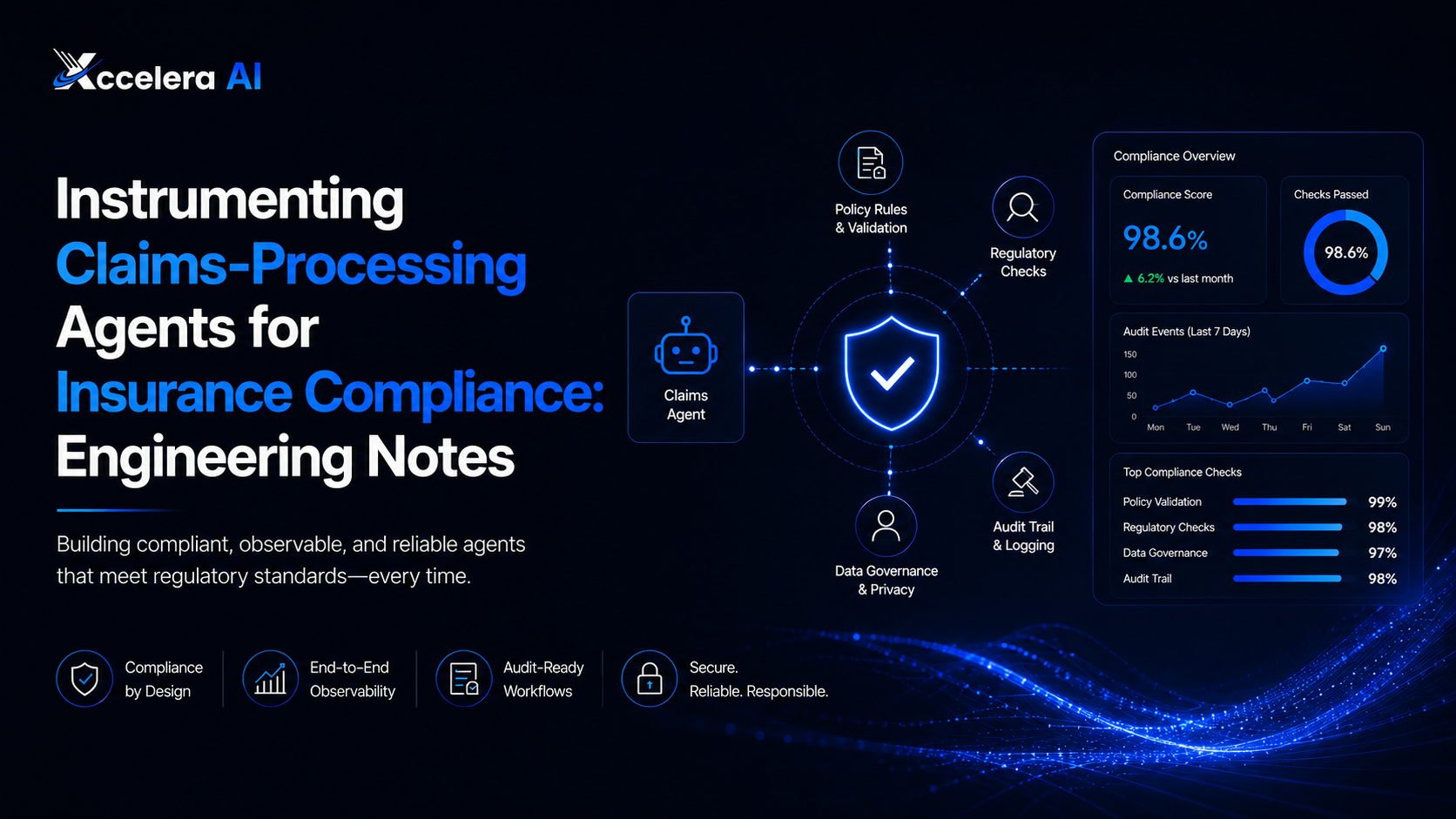
Claims processing agent compliance sits at the center of insurance engineering roadmaps this year, as automated triage, fraud scoring, and payout recommendation systems move from pilot programs into production determinations that regulators now examine directly.
Engineering teams that shipped agent-based claims workflows over the past two years often built for throughput first, treating audit trails, access controls, and approval gates as afterthoughts. That gap becomes visible the moment a market conduct examiner asks for a decision trace. This piece documents the instrumentation layer claims engineering teams need going into 2026 examinations: audit architecture, role-based access, human checkpoints, guardrails, and version control built for regulatory scrutiny rather than uptime alone.
Insurance Claims Automation Faces a Compliance Instrumentation Gap
Regulators have stopped treating AI-assisted claims decisions as a special category exempt from existing rules. State adoption of the NAIC Model Bulletin on the Use of Artificial Intelligence Systems now spans more than 20 jurisdictions, and examiners are actively building the infrastructure to test insurer AI governance programs during routine market conduct reviews. That shift matters because the underlying Unfair Claims Settlement Practices Act already applies fully to AI-assisted decisions, whether or not an insurer built a formal governance program around the agent making them.
Over 20 states have adopted AI governance requirements that apply directly to automated claims decisions, and a 12-state pilot of the NAIC's AI Systems Evaluation Tool began running examiner-facing questionnaires in January 2026. Teams that shipped a claims agent without instrumenting it for evidence production are now retrofitting under exam pressure, a far more expensive path than building observability from day one.
Why Retrofitting Costs More Than Building It In
Retrofitting audit infrastructure after deployment means reconstructing decision logic from incomplete logs, interviewing engineers who may have left the team, and hoping the agent's original prompt versions were preserved somewhere. None of that produces the tamper-resistant record an examiner expects to see.
Audit Trail Architecture for Every Claims Decision an Agent Makes
A standard application log confirms that an API call happened. It does not explain why a claims agent denied a payout, escalated a file, or approved one automatically. Compliance-grade audit trails capture the system prompt version in effect, the retrieved policy and claims context, every tool invocation, and the final state transition that produced the outcome.
The distinction between a feature and a substrate property matters here. An audit trail configured as an optional feature can be switched off by an operator under load, deliberately or by accident. An audit trail built as a substrate property is captured by default on every agent action, scoped to the tenant, append-only, and exportable in whatever format a regulator requests.
| Log Type | What It Captures | Regulatory Value |
|---|---|---|
| Application log | API call occurred, timestamp, status code | Confirms system activity only |
| Agent execution trace | Prompt version, tool calls, context retrieved | Explains the decision path |
| Approval record | Who approved, when, what evidence they reviewed | Demonstrates human oversight |
| Version history | Every code and prompt change, with rollback points | Proves what logic ran on a given date |
Claims platforms that treat these four layers as a single connected record, rather than four disconnected systems an engineer has to reconcile manually, cut evidence production time from weeks to hours during an exam.
Role-Based Access Controls That Satisfy Insurance Regulatory Examiners
Examiners increasingly ask a version of the same question during governance reviews: who can change a claims agent's logic, and who approved that they should be able to. A flat permissions model where any engineer can push a change to production claims logic fails that question immediately, regardless of how good the underlying agent is.
Effective role separation for claims-processing agents typically follows three tiers.
Administrators configure the agent's connections, budgets, and deployment targets, but do not necessarily author the claims logic itself
Developers build and modify the agent's decision workflows, with every change captured in version history before it reaches production
Viewers, including compliance and audit staff, observe agent behavior and pull evidence without holding write access that could alter a live claims determination
Single sign-on through an identity provider, paired with this tier structure, gives examiners a straightforward answer to a question that otherwise requires reconstructing access logs after the fact.
Human Approval Gates for High-Stakes Claims Determinations
Not every claim determination needs a person in the loop before it executes. A low-dollar, low-risk auto-approval carries different exposure than a six-figure payout denial. The engineering task is drawing that line deliberately, then enforcing it in code rather than in a policy document nobody checks at runtime.
A control documenting model versioning alongside a prompt audit trail satisfies overlapping requirements across SOC 2 change management, ISO 42001 operational controls, and AI Act record-keeping provisions simultaneously, because the same underlying evidence maps to multiple frameworks at once.
That overlap is a practical argument for building the approval gate and its evidence trail once, correctly, rather than maintaining separate compliance artifacts per framework. A configurable gate that pauses a claims agent at a defined dollar threshold, routes the file with its full context to a human reviewer, and logs the reviewer's decision alongside the original agent recommendation gives auditors exactly the comparison they look for: what the agent recommended, what the human decided, and whether they diverged.
Guardrail Layers That Catch PII Exposure and Cost Overruns in Claims Pipelines
Claims files carry Social Security numbers, medical records, and financial account details by default. An agent processing that data without dedicated detection controls is one malformed prompt away from a reportable exposure event.
PII detection scans every input and output for patterns matching Social Security numbers, phone numbers, and payment card data, blocking the transaction before sensitive data leaves the system
Prompt injection prevention identifies attempts to override the agent's instructions through claimant-submitted text, a growing vector as more intake happens through unstructured channels
Cost controls enforce per-request and per-day token budgets, preventing a misconfigured agent from generating runaway spend across a high-volume claims queue
Relevance checking keeps the agent within its defined claims domain, rejecting requests that fall outside its intended scope rather than improvising an answer
Guardrails positioned at the business logic level, rather than bolted on as external middleware, are harder for a claims team to accidentally bypass under deadline pressure.
Version History and Rollback as Evidence for Regulatory Audits
Examiners frequently ask what logic governed a specific claims decision on a given date months earlier. Without granular version history tied to deployment timestamps, that question has no reliable answer, and engineering teams end up reconstructing agent behavior from memory or scattered commit messages.
A rollback capability that restores a prior agent version, paired with a timestamped change log, turns that reconstruction into a five-minute lookup instead of a multi-day exercise pulled together under exam deadline pressure.
Version history also protects against a subtler risk: an agent update deployed to fix one issue quietly changing claims outcomes for a class of claimants without anyone noticing until an examiner flags the pattern. Timestamped rollback points let a compliance team isolate exactly which version produced a disputed decision, compare it against the current logic, and demonstrate to a regulator that the discrepancy was caught, documented, and corrected through a controlled process rather than an unmanaged code push.
Xccelera's Governed Infrastructure for Claims-Processing Agents
Instrumenting claims agents for compliance is not a one-time engineering sprint. It requires an AI agent lifecycle management platform that treats audit trails, role-based access, human approval gates, and guardrails as foundational architecture rather than optional add-ons layered on after deployment.
Xccelera built its agent platform on exactly that premise: every generated agent ships with governance embedded at the code level, version history and rollback are native rather than bolted on, and role separation between administrators, developers, and compliance viewers is enforced by design.
For insurance engineering teams facing 2026 examinations, that means the evidence an auditor asks for already exists in the system, rather than living in someone's memory of a deployment from eight months ago. Explore more about how Xccelera approaches governed agent infrastructure at xccelera.ai.